


Key Takeaways
- Back office outsourcing in the Philippines is not just a cost decision. The real executive question is whether the provider can help you build a controlled, visible, and accountable operating model.
- The best back-office outsourcing provider should support role clarity, process documentation, performance management, transparent pricing, and long-term scalability.
- Finance, accounting, procurement, HR administration, data processing, mortgage support, healthcare administration, and industry-specific workflows are strong candidates for offshore back office teams.
- Executives should be careful with providers that lead only with savings, avoid discussing management structure, or treat specialized back-office work like generic task support.
- A co-management model gives companies more operational control than traditional outsourcing because offshore team members work as an extension of the client’s business.
For several years, I led operations for a dental group with about 40 dentists and more than 200 employees. The business had demand, but growth was often limited by a shortage of qualified people to support the work.
That experience helped shape Connext and the advice I give business owners today. Do not start by asking what you can send offshore. Start by identifying where capacity constraints are keeping your best people from doing higher-value work.
Back-office outsourcing services can help relieve that pressure, but success depends less on location or hourly rate than on how the work is defined, the team is selected, performance is managed, and control is maintained.
The Philippines Is a Mature Operating Market, Not an Experiment
Business owners sometimes talk about the Philippines as though it is a new or untested labor market. It is not. The country has supported global companies for decades across customer service, finance and accounting, healthcare administration, technical support, and other business functions.
That talent base is also expanding beyond the country’s traditional business centers. The industry is projected to create 1.1 million additional direct jobs by 2028, with 54% of those roles expected to be located outside Metro Manila. For business owners, that matters because it points to a broader recruiting market across the Philippines rather than a model dependent on one location.
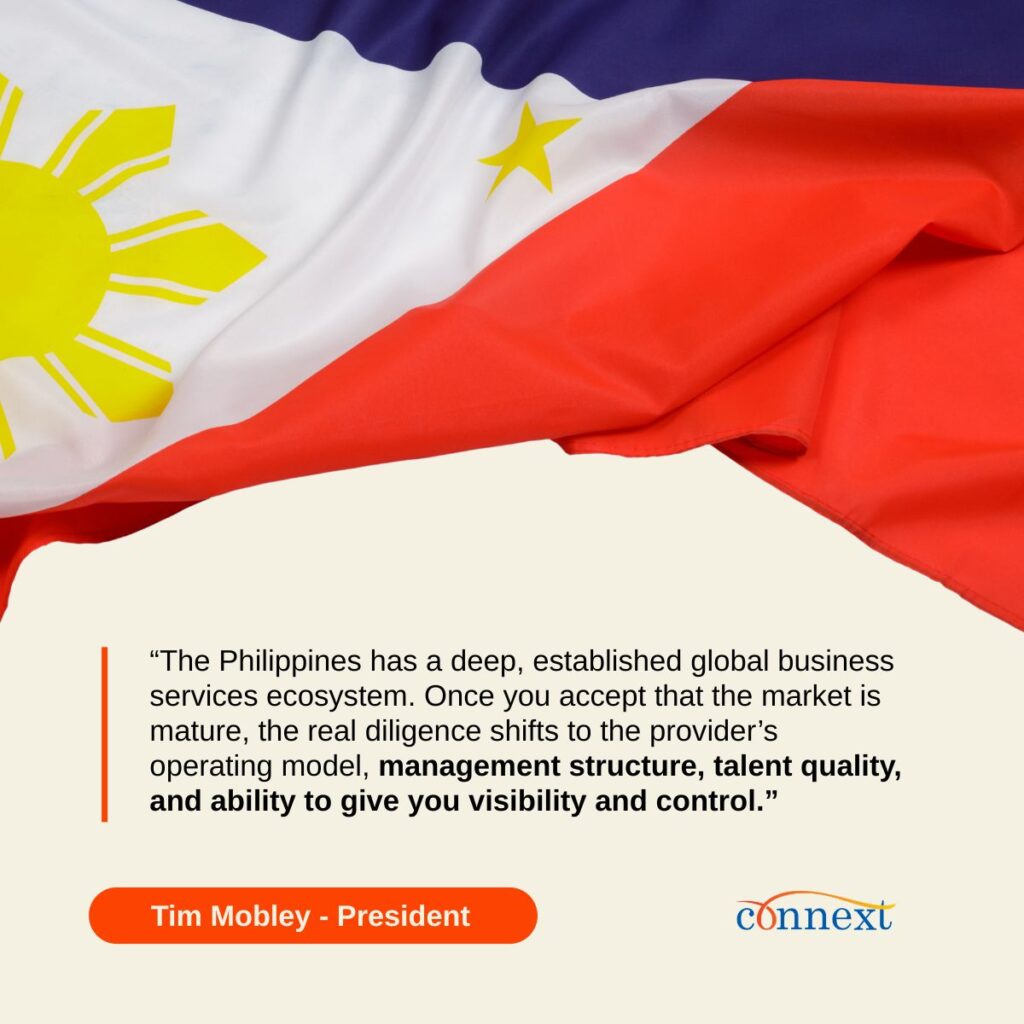
Once you recognize the depth and reach of the Philippine talent market, the real diligence shifts to the provider’s operating model, management structure, talent quality, and ability to give you visibility and control.
My First Rule: Do Not Outsource a Problem You Have Not Defined
I learned this in healthcare operations. When a workflow is unclear, adding people does not fix it. It gives the confusion of more places to travel.
Before you contact Philippines outsourcing companies, write down the business problem in plain language. Is the month-end close late because the team lacks capacity? Are invoices waiting for review? Is HR administration consuming the time of senior employees? Are procurement specialists spending their week maintaining vendor records instead of negotiating and managing risk?
A role description is not enough. You need a basic operating definition: what comes in, what the team does, what good work looks like, what requires approval, and what happens when something falls outside the standard process. The process does not need to be perfect before you start. It does need an owner.
Decide Whether You Want a Service or Your Own Team
In a traditional outsourced service, the provider owns the delivery method. You care about the result, but you may have limited involvement in who performs the work, how they are trained, or how daily decisions are made.
That model can be useful for a tightly standardized service. It is less attractive when the work sits inside your finance, HR, procurement, healthcare, mortgage, or operating systems and requires regular judgment, collaboration, and process changes.
The other option is to build a client-controlled global capability team. In this model, the provider handles recruiting, employment, payroll, benefits, infrastructure, and local support. Your leaders interview the candidates and make the final hiring decision, define priorities, train the work, set the KPIs, and retain decision-making authority.
I generally favor that model for back-office work because it preserves ownership. You are not buying an anonymous output. You are building a team that learns your business.
What You Should Outsource First
Do not begin by moving the most complex or sensitive workflow in the company. Start with work that is recurring, teachable, measurable, and important enough to manage well.
- Finance and accounting support
Accounts payable, accounts receivable, invoice processing, reconciliations, billing support, expense review, payment documentation, and close support can be strong starting points. When companies outsource accounts payable services, the goal should be to improve cycle time, accuracy, and visibility, not simply move invoices to a lower-cost location.
- HR and payroll outsourcing
Employee record maintenance, onboarding documentation, timekeeping support, payroll data preparation, benefits administration support, recruiting coordination, and HR reporting are often suitable. These functions involve confidential information, so permissions, review steps, and escalation rules need to be explicit.
- Procurement support
Purchase order processing, supplier follow-up, vendor maintenance, quote collection, order tracking, invoice matching, and reporting can give procurement leaders more time for sourcing strategy, negotiations, supplier performance, and risk.
- Data and document processing
Document indexing, records maintenance, database updates, quality checks, form processing, audit preparation, and reporting support are good candidates when the rules and exception paths are clear.
- Industry-specific administration
Mortgage package preparation, healthcare administration, insurance documentation, legal operations support, fintech workflows, and SaaS operations can work well, but they require more careful recruiting, training, access controls, and quality review.
- Customer service and technical support
Customer service and technical support services operate as connected functions. Customer inquiries, order support, account assistance, basic troubleshooting, ticket management, and tier-one technical support can also be handled effectively by offshore teams when service standards are well defined.
The strongest models combine capable people with disciplined workflows so customers receive reliable support without losing the human judgment needed for more complex issues.
A Lesson From Ranger School: Capacity Is Useful Only When It Is Directed
At Ranger School, I learned that persistence matters, but effort without a clear objective is not enough. Business operations work the same way. A larger team does not automatically create a better operation.
The offshore team needs priorities, standards, feedback, and a manager who can make decisions. Your provider can support attendance, coaching, engagement, infrastructure, and local management. Your company still needs an internal owner who understands the process and is accountable for the outcome.
That internal ownership is what turns additional capacity into real operating leverage. Without it, work may get completed, but improvement stalls. With it, the team can learn the business, solve recurring problems, and take on more responsibility over time.
I use a simple rule: outsource capacity, not accountability. The company may expand who performs the work, but leadership must still own the standards, decisions, and results. That principle is also how the story of Connext began.
How to Evaluate a Philippines Outsourcing Provider
Spend less time on the sales presentation and more time testing how the operating model will work after launch. The goal is not simply to find a provider that can supply talent, but to determine whether the provider can help you build a stable, visible, and accountable operating unit while your company retains control over priorities, standards, and outcomes.
1. Evaluate How the Provider Recruits for Your Specific Roles
Ask the provider to explain how candidates are screened for the actual work, not just for general communication ability. Finance, HR, procurement, healthcare administration, mortgage operations, and other specialized functions require role-specific assessment, systems familiarity, sound judgment, and the right working style. Your managers should be able to interview finalists and make the final selection, while the provider handles sourcing, screening, and preparation.
2. Understand Who Will Manage and Support the Team
Clarify who supports the team after launch and what each party owns. The provider may handle local employment, attendance, engagement, HR support, infrastructure, and escalation coordination, while your internal leaders remain responsible for process priorities, training, performance expectations, and business decisions. There should be named owners on both sides, along with a clear process for coaching, feedback, absences, corrective action, and replacements.
3. Confirm You Will Have Ongoing Process Visibility
Ask how performance will be monitored before the team begins working. Your managers should be able to see the measures that matter to the process, such as backlog, aging, turnaround time, error rates, rework, exceptions, schedule adherence, and deadline performance. The provider should work with your KPIs rather than relying on generic scorecards, and reporting should help both sides identify causes, assign corrective action, and manage the work consistently.
4. Test Whether the Team Can Work Within Your Technology Environment
Review how the team will operate within your ERP, accounting platform, HRIS, ticketing system, document environment, communication tools, and security requirements. Ask who configures equipment, manages access, provides IT support, and handles account removal when someone leaves. The provider should be able to explain how the team will work reliably within your systems, including access controls, device standards, remote connectivity, downtime procedures, and escalation support.
5. Review Pricing for Clarity, Flexibility, and Scale
Ask for a full explanation of the outsourcing company’s service model and what the pricing includes and what changes as the team grows. Review recruiting, onboarding, equipment, HR support, management, IT, replacements, notice periods, shift requirements, contract minimums, and annual adjustments. Transparent pricing should help you understand the full operating model, and it should make clear how the arrangement can adapt as roles, volume, location, or service requirements change.
6. Assess Security, Privacy, and Access Controls
What are the access controls, device rules, audit trails, confidentiality practices, and incident procedures? The Philippines has a national privacy framework under the Data Privacy Act of 2012, but your diligence still needs to address the actual systems, people, permissions, and processes involved in your engagement.
My 90-Day Advice: Stabilize Before You Scale
The first 90 days should focus on building a reliable operating rhythm, not adding headcount as quickly as possible. A phased approach gives the team time to learn the work, strengthen documentation, correct gaps, and prove that the model can perform consistently before it expands.
- Days 1 to 30: Train and observe. Document the workflow, establish access, pair team members with internal subject-matter experts, define the escalation path, and begin measuring a small number of operational indicators.
- Days 31 to 60: Correct and standardize. Review errors, identify unclear instructions, refine job aids, confirm roles, and establish a weekly operating review. The purpose is not to punish mistakes. It is to make the process teachable.
- Days 61 to 90: Prove repeatability. Confirm that performance is stable without constant intervention. Decide what can expand, what should stay unchanged, and whether additional roles would strengthen the same workflow.
The goal of the first 90 days is not maximum headcount. It is a stable operating unit that can grow without creating new management debt.
HELP US REACH MORE PEOPLE
Like what you’re reading?
Add Connext as a preferred source on Google — it only takes a moment and helps more professionals find our content.
- 1 Click Add as preferred source below
- 2 Sign in to your Google account if prompted
- 3 Check the box next to Connext Global to confirm your preference
- 4 Close the tab — you're done. Thank you!
A Founder’s Warning About Cost Savings
I care about the cost. Every business owner should. In the military, we used the phrase DROOM: don’t run out of money. Cash discipline matters.
But the cheapest provider is rarely the lowest-cost operating decision if the work has to be redone, managers lose visibility, employees turn over, or customers and internal teams feel the consequences.
The financial case should include quality, management time, continuity, speed, process visibility, and the opportunity cost of keeping experienced people buried in transactional work.
A good offshore model creates operating leverage. It gives the company more capacity while preserving the controls that make the business reliable.
For a closer look at how pricing structure affects that control, read “Transparent Management Fees in Staff Augmentation: What Operators Should Know Before They Sign” by Ron Rhodes, Connext EVP and GM. It covers fee visibility, cost accountability, and the questions operators should ask before choosing an offshore staffing model.
What I Believe Business Owners Should Do
Start with a constraint, not a country. Define the process. Assign an owner. Select work that can be taught and measured. Keep control of priorities and outcomes. Then choose a partner that can build the people, infrastructure, and operating discipline around your requirements.
That is how I think about back office outsourcing services. It is not a transaction where a company hands off unwanted work. It is a practical way to build a global operating capability that the client still leads.
The Philippines can be an excellent place to build that capability. The success of the decision will come from the quality of the operating model you put around the talent.
That principle has shaped how we have built Connext. Since its founding, we have grown from a single Philippines delivery site into a co-managed staffing partner supporting clients across healthcare, finance and accounting, IT, and customer experience.
Our fifth consecutive Inc. 5000 recognition is one milestone in that growth, but the more important point is this: the model works best when clients keep control and the partner builds the structure around them.
Final Takeaway
Outsourcing back office work to the Philippines can create real operating leverage, but only when business owners stay involved in how the team is built and managed. My advice is to start with a clearly defined process, assign internal ownership, establish measurable expectations, and treat the offshore team as part of the business rather than an outside vendor. The right provider should give you better visibility, stronger process discipline, and room to grow without losing control. Cost matters, but accountability, quality, and management structure will determine whether the model succeeds.
Frequently Asked Questions
Back office outsourcing services use an external or offshore team to support internal functions such as finance, accounting, HR administration, payroll support, procurement, data processing, reporting, and document management. The stronger model keeps process ownership, approvals, and performance standards with the client.
Companies consider outsourcing to the Philippines because the country has an established global-services workforce with experience across finance, administration, customer operations, healthcare support, technology, and other business functions. The decision should still be based on role fit, management structure, process visibility, and operational control, not location alone.
Filipino outsourcing generally means building or engaging a team in the Philippines to support business operations. A Filipino outsourcing company may provide recruiting, employment, payroll, benefits, facilities, technology support, and local management while the client directs the work and retains authority over priorities and outcomes.
A Filipino BPO may deliver a defined service using the provider’s own operating method. A client-controlled offshore team works more directly inside the client’s systems, processes, KPIs, and management cadence. The right choice depends on whether the company wants an outsourced output or a team that functions as an extension of its operation.
When comparing Philippines outsourcing companies, review the recruiting process, client interview rights, management support, pricing structure, technology fit, security practices, reporting cadence, onboarding plan, and ability to scale. The best outsourcing services Philippines providers are transparent about how the model works after launch and can explain how they will support accountability, process visibility, team performance, and long-term operational control.
Start with recurring, teachable, measurable work that has a clear internal owner. Common starting points include accounts payable support, accounts receivable, reconciliations, HR administration, payroll preparation, procurement transactions, document processing, reporting, and customer or technical support.
Accounts receivables outsourcing places recurring receivables work with a trained external or offshore team. That team may support invoicing, cash application, account follow-up, aging reports, documentation, and exception tracking while the client retains policy decisions, approval rights, customer escalation ownership, and financial oversight.
Human resources and payroll services can include employee record maintenance, onboarding administration, timekeeping support, payroll data preparation, benefits support, reporting, and recruiting coordination. Leaders should define what remains an internal decision, who can access sensitive data, how exceptions are escalated, and where final approvals sit.
For HR & payroll outsourcing, ask who owns payroll approval, how confidential data is protected, which systems the team will use, how cutoff dates are managed, what happens when records are incomplete, and how local employment or tax questions are escalated. The offshore team can support the workflow, but accountable client leaders should retain policy and approval decisions.
In a traditional BPO arrangement, the provider typically owns more of the delivery process. In a co-management model, the provider supports recruiting, employment, infrastructure, local management, and team engagement while the client leads training, priorities, systems, KPIs, and business decisions.
The right KPIs depend on the function. Common measures include turnaround time, error rate, backlog, aging, exception volume, task completion, documentation accuracy, response time, process adherence, and stakeholder satisfaction. The client should select metrics tied to the business outcome rather than accept a generic scorecard.
Timing depends on role complexity, candidate availability, system access, documentation, training, and client readiness. Specialized finance, healthcare, mortgage, procurement, or HR roles may require more preparation than general administrative work. A phased launch is usually more reliable than adding headcount before the workflow is stable.
Considering back office outsourcing in the Philippines?
Speak with a Connext specialist about building a dedicated team with clear ownership, transparent pricing, measurable KPIs, and the operational discipline needed to scale with confidence.
Visit Connext Global Solutions or email sales@connextglobal.com.