


Key Takeaways:
- MSPs can scale support capacity by moving routine, repeatable support work into a structured offshore help desk model while keeping control of standards, tools, KPIs, and escalation paths.
- The goal is to protect senior technicians from being pulled into tickets that can be handled through training, documentation, and clear process.
- Offshore tech support works best when the team is embedded into the MSP’s ticketing system, documentation, client expectations, SLAs, and management rhythm.
- Recent Gartner and McKinsey research shows that AI and automation are changing support operations, but human judgment, training, empathy, and operating discipline still matter.
- The strongest MSP support models combine local technical leadership, offshore capacity, AI-assisted workflows, documented escalation, and regular performance review.
Managed Service Providers (MSPs) grow by building support models that allow their teams to focus on the work where they add the most value. As ticket volume increases, the key is creating the right structure around people, processes, and technology.
Scaling support capacity starts with understanding which work should stay with your core team and which work a trained offshore team can support effectively. When routine support is documented, measured, and aligned with clear escalation paths, MSPs can strengthen their operations while giving clients a more consistent support experience.
In this article, I’ll explain how MSP help desk outsourcing can help MSPs expand support capacity, improve operational consistency, and build a stronger support model while maintaining control of their processes, tools, and service standards.
What Does It Mean for MSPs to Scale Support Capacity?
Scaling support capacity means building a model that allows MSPs to serve more clients, extend coverage, and maintain service quality as they grow. That requires clear processes, reliable documentation, defined escalation paths, performance visibility, and alignment across people and technology.
A strong support structure enables faster response times, consistent first-level support, after-hours coverage, and more capacity for higher-value work. MSP help desk outsourcing can support this growth when the offshore team operates as an extension of the MSP, using the same tools, workflows, service standards, and performance expectations.
Connext helps MSPs build integrated support teams that fit into their existing operating model. This approach provides additional capacity while maintaining visibility, collaboration, and alignment across the support function. Remote help desk and technical support teams are structured around ticketing systems, support portals, call routing, monitoring, and technical workflows.
Here are 10 ways MSPs can scale support capacity effectively.
1. Separate Core Team Work From Scalable Support Work
Core teams should focus on complex escalations, client-specific decisions, security-sensitive issues, architecture, and strategic initiatives, while a trained support team manages repeatable activities such as ticket triage, password resets, account access support, basic troubleshooting, monitoring alerts, documentation updates, and first-level help desk support.
In my opinion, the strongest MSPs match the right work with the right level of expertise. A technician’s ability to solve a problem does not always mean they should be the person handling every ticket. Creating clear ownership improves efficiency while protecting technical talent.
2. Extend Coverage with a Structured Offshore Support Team
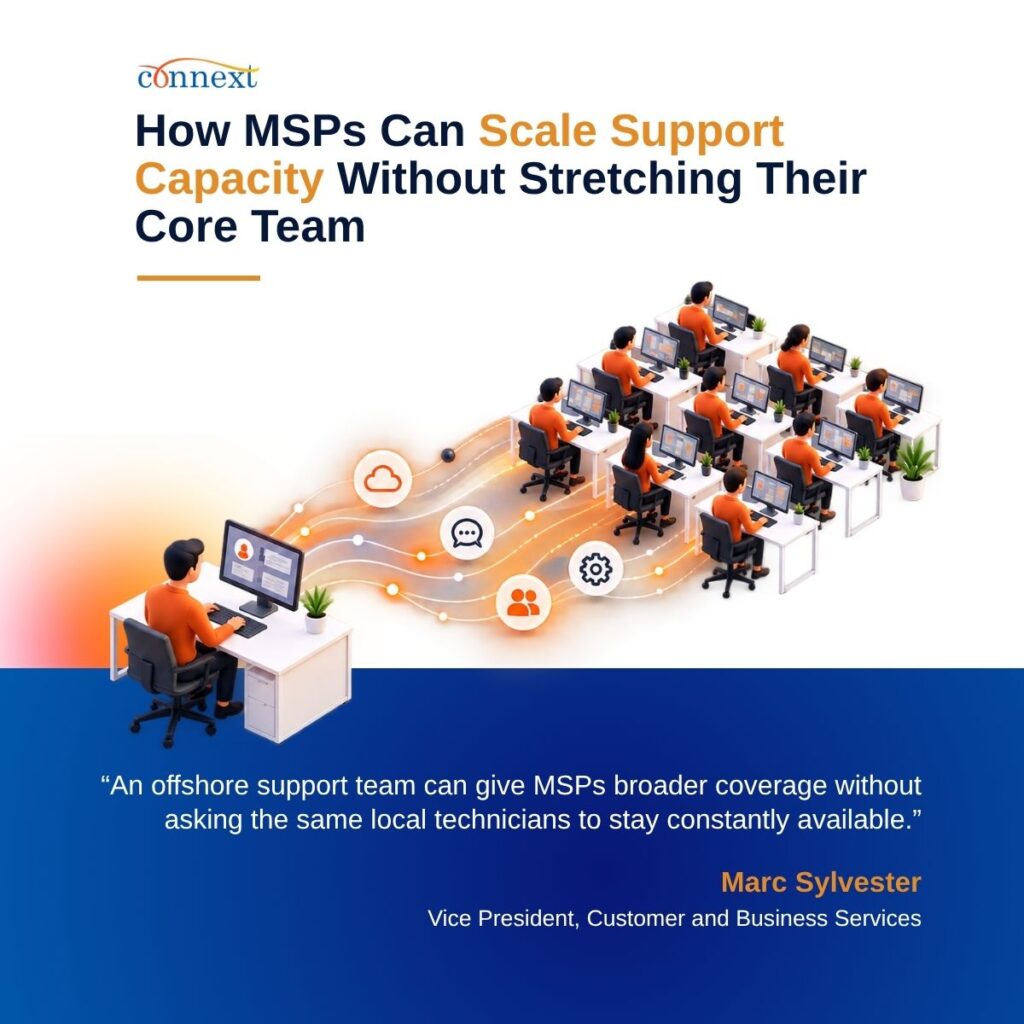
Client expectations continue to expand beyond traditional business hours. A structured offshore support team can help extend coverage while maintaining consistency across the support experience through after-hours response, weekend availability, overnight monitoring, faster ticket acknowledgment, and better workload distribution.
Offshore support works best when the team follows the same ticketing systems, SLAs, documentation standards, and escalation procedures as the internal MSP team. The strongest models operate as an extension of the MSP rather than a separate support function.
For MSPs evaluating the model, Connext’s offshore outsourcing guide for IT Managed Service Providers provides a useful starting point.
3. Integrate the Offshore Team Into the MSP’s Operations
A scalable support model requires visibility and alignment.
I believe it is equally important to review current processes and tools so we can help the client grow while also improving efficiency through technology and stronger processes.
That means working within the client’s existing support platforms, documentation, service standards, escalation processes, and reporting structure.
This is what separates a true support extension from traditional outsourcing. The team should understand the MSP’s standards, workflows, and client expectations. When everyone works from the same systems and processes, leaders gain better visibility and clients receive a consistent experience.
4. Protect Senior Technicians’ Time
Senior technicians are valuable because they bring experience, client knowledge, and technical judgment. A scalable support model helps move routine activities into the right workflow so senior team members can focus on complex escalations, infrastructure improvements, security initiatives, root-cause analysis, technical leadership, and client strategy.
In my perspective, MSP help desk outsourcing is about creating more room for them to contribute where their expertise has the greatest impact. When routine support is handled through clear processes, the entire team becomes more effective.
5. Build Clear Escalation Paths
Strong escalation processes create consistency across every level of support by defining which issues can be resolved at each level, when escalation should occur, the required troubleshooting steps, documentation expectations, communication requirements, and responsible owners.
In my experience, good escalation protects both the client and the internal team. The client gets faster movement on the issue. The core team receives better context. The offshore team learns what good judgment looks like over time.
For more specialized needs, MSPs may also consider offshore technical support engineer roles that can support advanced troubleshooting, proprietary applications, case management, and more technical support workflows.
6. Use Documentation as a Growth Tool
Documentation creates consistency and helps support teams scale effectively. A detailed help desk SOP and well-maintained knowledge base give teams a clear framework for resolving issues, onboarding new team members, and maintaining service quality.
MSPs should document common ticket types, troubleshooting steps, client-specific systems, access procedures, escalation criteria, SLA expectations, and approved responses. When knowledge is captured and shared, support teams can grow without relying on individual employees for every answer.
7. Manage Performance Through KPIs
Clients need to have clearly defined expectations, updated training materials and the appropriate means to measure the success of their teams.
Useful metrics include first response time, resolution time, SLA adherence, first-contact resolution, escalation rate, ticket backlog, documentation quality, and client satisfaction.
Ticket response times, outage resolution, and clearly defined customer metrics are what is most important to measuring service quality and success. From my perspective, these measures matter because they connect day-to-day support activity with the customer’s actual experience.
8. Combine AI, Offshore Support, and Human Oversight
AI will be able to help team members be more efficient, and it can handle simpler, high-volume, repeatable tasks such as password resets, basic diagnostics, and ticket routing. What AI cannot reliably do is manage emotionally charged customers, make strong judgment calls, or take accountability when something goes wrong. The human interaction provided by an operations team is a retention asset, and AI cannot replace that.
Human judgment remains essential for complex issues, client communication, and quality decisions. From my point of view, the strongest MSP support models combine technology with skilled people. AI can improve speed and consistency, but trained teams provide the accountability, communication, and decision-making needed to maintain client trust.
9. Make Support Part of the Client Experience
MSP support is more than resolving technical issues. Every interaction contributes to how clients view the MSP relationship. A strong support experience includes clear communication, timely updates, professional interactions, consistent follow-up, and organized escalation.
Offshore teams should understand client expectations, communication standards, and the MSP’s service approach. I believe the best support teams are measured by how effectively they help clients feel supported throughout the process.
Connext’s article on customer service vs. customer experience outsourcing is relevant because the same distinction applies to MSPs. Resolving the ticket matters, but the full experience around the ticket matters too.
10. Scale in Phases
Gradual scaling gives MSP leaders better visibility and control. A phased approach allows teams to build confidence, measure results, and improve processes over time.
A phased model may include:
- Phase 1: Ticket triage and basic support
- Phase 2: Troubleshooting and monitoring
- Phase 3: Extended coverage and documentation
- Phase 4: Specialized technical support
Connext can offer help desk teams starting with basic Tier I functions and work with clients to develop career path programs that help team members advance into Tier II or junior engineering positions. We can also hire Tier II and engineering professionals in the Philippines, Colombia, and India who are ready to become part of the client’s team. Some clients may initially choose to start with Tier I support, allowing team members to work alongside the existing client team, develop their skills, and gradually take on more complex responsibilities.
HELP US REACH MORE PEOPLE
Like what you’re reading?
Add Connext as a preferred source on Google — it only takes a moment and helps more professionals find our content.
- 1 Click Add as preferred source below
- 2 Sign in to your Google account if prompted
- 3 Check the box next to Connext Global to confirm your preference
- 4 Close the tab — you're done. Thank you!
Why MSP Core Teams Need the Right Support Structure
As MSPs grow, they need a support model that expands capacity without weakening service quality. The strongest operations balance internal expertise, documented processes, technology, and clear ownership so senior technicians can focus on complex issues, strategic improvements, and client priorities.
AI can improve efficiency, but it does not remove the need for skilled people and disciplined workflows. Gartner’s 2026 customer service research reports that 91% of customer service leaders are under pressure to implement AI, while more than 80% of organizations expect human roles to expand alongside it. McKinsey’s 2026 customer care research also found that nearly 70% of respondents believe empathy and trust will continue to require human involvement.
Based on my 25+ years leading customer support and technical teams, I have found that a strong help desk SOP is the foundation for consistent execution. For MSPs evaluating help desk outsourcing, the decision should go beyond adding capacity. Team structure, coverage, technical capability, service expectations, and performance visibility all shape the right operating model and pricing.
Final Thoughts
MSP help desk outsourcing can help extend an MSP’s capabilities by adding trained support resources that work within existing workflows, tools, and service standards. The goal is to create a stronger operating model where routine support is handled efficiently and experienced technicians can focus on higher-value technical work.
Frequently Asked Questions
MSP help desk outsourcing is a support model where Managed Service Providers extend their technical support capabilities through an external team that works within their processes, tools, and service standards.
Unlike traditional outsourcing models, the strongest outsourced help desk services operate as an extension of the MSP team. The support team follows defined workflows, escalation paths, documentation standards, and reporting requirements to maintain consistency across the client experience.
The decision between service desk outsourcing and expanding an internal team depends on the MSP’s goals, coverage needs, technical requirements, and operating model.
A structured service desk outsourcing services approach can help MSPs expand capacity, support multiple time zones, and create more flexibility while allowing internal technicians to focus on complex technical work. The right model depends on how the MSP defines responsibilities, manages performance, and integrates the extended support team.
When evaluating outsourced help desk providers, MSPs should look beyond staffing availability. The right provider should understand technical workflows, documentation standards, escalation management, and client experience expectations.
Important considerations include:
– Experience with IT helpdesk outsourcing
– Support coverage requirements
– Knowledge management processes
– Reporting capabilities
– Alignment with PSA and ticketing platforms
– Ability to support a white label service desk model
Outsourced help desk pricing varies depending on factors such as coverage hours, technical skill requirements, team structure, service expectations, and the level of support required.
Pricing for an outsourced support desk may differ based on whether an MSP needs first-level ticket support, technical escalation support, after-hours coverage, or specialized roles. The right approach is to evaluate pricing alongside service quality, operational fit, and long-term scalability.
A service desk SOP (standard operating procedure) defines how support teams handle requests, resolve issues, document work, and escalate tickets. A strong service desk standard operating procedure helps create consistency across the support operation.
Similar frameworks, including a helpdesk SOP, help desk standard operating procedure, and service desk SOP, provide teams with clear guidance for daily execution. For MSPs, documented processes are essential for maintaining quality as support volume grows.
Effective support management requires measurable performance indicators. Common service desk key performance indicators include:
– First response time
– Resolution time
– SLA adherence
– First-contact resolution
– Escalation rate
– Ticket backlog
– Client satisfaction
Yes. A white label help desk allows MSPs to extend their support capabilities while maintaining their own client-facing brand experience.
A white label service desk model can support MSPs that want additional capacity while keeping communication standards, workflows, and client relationships aligned. For MSPs specifically, white label help desk for MSP solutions can provide additional support coverage while allowing the MSP to maintain ownership of the client experience.
Outsourced IT help desk services help MSPs expand support capabilities by adding structured resources for routine support, ticket management, monitoring, and technical assistance.
IT help desk outsourcing services and IT service desk outsourcing models can help MSPs create more flexible support operations while maintaining clear processes and accountability. The goal is creating a stronger managed service delivery model.
Many MSPs consider whether to outsource desktop support as client needs expand. Desktop support outsourcing can help with user support requests, endpoint troubleshooting, account access issues, routine technical tasks, and ticket triage
An IT help desk roadmap helps MSPs plan how their support operation will evolve over time. A strong roadmap may include defining support tiers, creating documentation standards, and establishing escalation paths. It also includes implementing KPIs, expanding coverage, and integrating automation and AI. This approach allows MSPs to scale intentionally rather than simply adding support resources as demand increases.
Ready to Scale MSP Support Without Overloading Your Core Team?
Connext helps MSPs build embedded offshore support teams that work inside your tools, workflows, KPIs, documentation, and escalation paths. The goal is not to hand off control. The goal is to add capacity while protecting service quality, client experience, and your senior technicians’ time.
Visit https://connextglobal.com/contact/ or email sales@connextglobal.com.