

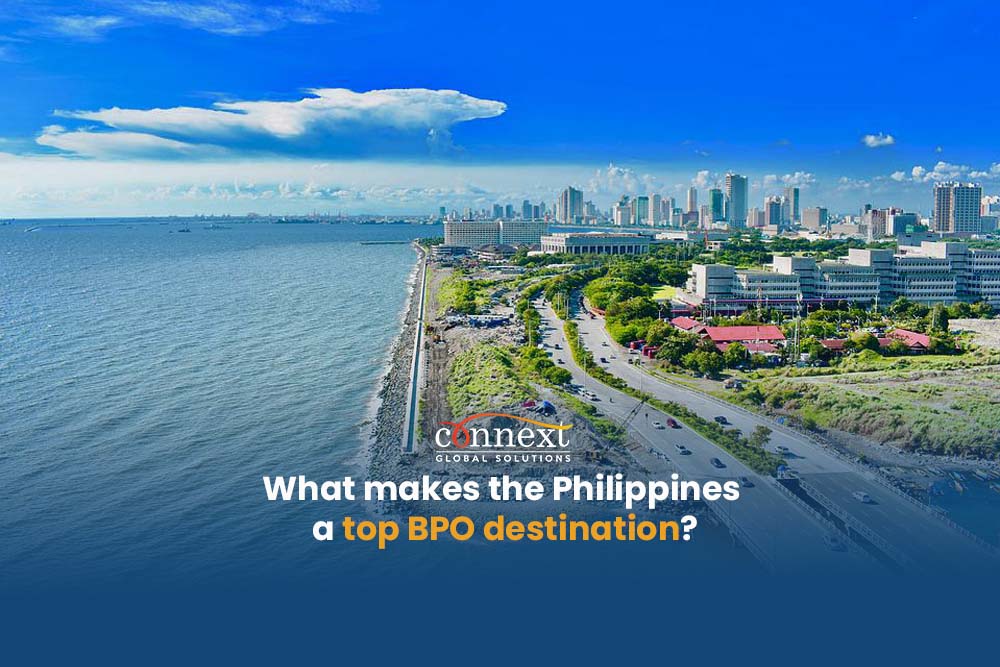
BPO Philippines: Paving the Way for a Successful Outsourcing Strategy
Key Summary:
- The Philippines ranked 50th in the 2025 WIPO Global Innovation Index, with a digital economy now worth 9.8% of national GDP — making it one of Asia’s most future-ready outsourcing destinations.
- Ranked 2nd in Asia in the 2025 EF English Proficiency Index, Filipino professionals bring strong communication skills, Western cultural alignment, and deep BPO experience to every engagement.
- The 2025 CREATE MORE Act allows BPO companies to maintain hybrid or fully remote work arrangements while retaining full tax incentives — reducing operational risk for businesses outsourcing to the Philippines.
- The Philippine BPO industry targets $59 billion in revenue and 2.5 million workers by 2028, supported by AI projected to unlock up to USD 50.7 billion in economic benefits by 2030.
BPO Philippines is one of the leading offshore destinations, offering businesses access to a skilled English-speaking workforce, significant cost savings, and a government-backed outsourcing industry generating over $40 billion in annual revenue. Outsourcing to the Philippines gives companies a proven, scalable strategy for sustainable growth.
For businesses considering outsourcing to the Philippines, the country’s growing reputation as a global innovation hub is a compelling reason to take notice. The Philippines climbed its way up and ranked 50th place in the 2025 Global Innovation Index (GII), produced annually by the World Intellectual Property Organization (WIPO); the world’s leading references for measuring innovation performance and competitiveness.
Additionally, WIPO has cemented the Philippines’ position as “one of the most consistent innovation climbers in Southeast Asia, East Asia, and Oceania,” emphasizing that the country’s trade-driven economy produces and absorbs advanced technologies and digital services.
Read more on what makes the Philippines a top choice for business process outsourcing.
Compatibility of Culture
One reason investors choose BPO Philippines for outsourcing activities is because of how the Philippine culture is compatible with that of the U.S.
The Philippines is an ideal staffing destination with its rich culture, high literacy and communication.
The Philippines is regarded as a highly literate and proficient English-speaking country. This is important in business process outsourcing especially when understanding tasks, communicating with clients, and interpreting important assigned documents.
According to the 2025 EF English Proficiency Index (EPI), which evaluated 123 countries and regions, the Philippines scored 569 points out of 800, earning a “High Proficiency” rating.
This places the country 28th globally and 2nd in Asia, trailing only Malaysia. A score at this level is sufficient for making professional presentations, understanding broadcast media, and reading business documents, all critical capabilities for companies outsourcing to the Philippines.
People skills and availability
Choosing BPO Philippines as an outsourcing and offshoring destination for business activities gives a wide access to highly specialized talent pool with the right technical skills.
The Philippines also has a highly specialized talent pool with employees who have worked for large multinational and business process outsourcing companies.
Businesses also have the option to enhance the professional development of business process outsourcing professionals by conducting seminars and information campaigns to further the professional growth and meet compliance with professional standards and regulations.
Business Environment
The Philippines’ national GDP grew by 5.7 percent in 2024, according to the Philippine Statistics Authority (PSA). All 18 regional economies continued to record positive growth that year, with the Services sector, which includes the BPO industry, remaining the primary economic driver, contributing 63.8 percent to national GDP.
The country’s digital economy, which encompasses the ICT and BPO industries, reached PhP 2.74 trillion in Gross Value Added in 2025, equivalent to 9.8 percent of the country’s GDP, a year-on-year growth of 5.4 percent. Employment in the digital sector reached 10.39 million workers, representing 21.2 percent of total employment nationwide.
Tax Incentives & WFH Policy
Investors outsourcing business processes to the Philippines remain eligible for a robust set of fiscal and non-fiscal incentives. Philippine tax laws continue to be legislated to promote investments in the growing BPO industry, and Economic Zone Enterprises registered with the Philippine Economic Zone Authority (PEZA) receive additional incentives.
Under the Corporate Recovery and Tax Incentives for Enterprises to Maximize Opportunities for Reinvigorating the Economy (CREATE MORE) Act, signed in 2025, all investment promotion agencies were given the flexibility to allow their registered BPO locators to maintain up to 50 percent work-from-home (WFH) arrangements while retaining full tax incentives. Meanwhile, BPO companies registered with the Board of Investments (BOI), rather than PEZA, can adopt a 100 percent work-from-home arrangement, giving businesses outsourcing to the Philippines maximum operational flexibility.
U.S.–Philippines Trade Relations
Trade relations between the U.S. and the Philippines date back to 1946, and the bilateral economic partnership continues to strengthen. As of 2023, total U.S.–Philippines goods trade reached $22.6 billion, with an estimated $12.3 billion in trade in services , with key U.S. imports from the Philippines including IT and BPO services, semiconductor devices, and computer peripherals. United States Department of State
By 2024, U.S. imports of services from the Philippines grew to an estimated $8.7 billion, more than double the 2020 figure, reflecting the continued expansion of outsourcing to the Philippines as a preferred destination for American companies.
Digital-First
The Covid-19 pandemic has emphasized the need for businesses to the adoption of unified cloud-based applications, new technology, and process automation.
Since the start of Covid-19, 85% of executives said their businesses have somewhat or greatly accelerated the implementation of technologies that digital enable employee interaction and collaboration, in a matter of weeks vs. months or even years (McKinsey)
The adoption of a digital-first approach plays an important role in the Philippine business process outsourcing industry, and the Philippine economy in general.
The demand for digital collaboration has become a permanent fixture of the modern workplace. According to Worklytics’ 2025 AI Adoption Benchmarks, 75 percent of global knowledge workers are now using AI tools regularly, with adoption nearly doubling in the last six months of 2024 alone — signaling a fundamental shift from experimental usage to mainstream integration across industries, including BPO.
Intelligent Automation: RPA & AI
The need for intelligent automation continues to accelerate for businesses outsourcing to the Philippines. The global Robotic Process Automation (RPA) market was estimated at $3.79 billion in 2024 and is projected to reach $30.85 billion by 2030, growing at a compound annual growth rate of 43.9 percent from 2025 to 2030 driven by the increasing integration of AI into organizational processes and the growing demand for hyper automation.
IBPAP Roadmap 2028
Under the IT-BPM Industry Roadmap 2028, the Philippine BPO industry has already created 450,000 new jobs and generated $10.5 billion in incremental revenue since 2022. IBPAP projects the industry will reach $42 billion in revenue and close to two million total jobs by 2026, on its way to an ambitious target of $59 billion in revenue and 2.5 million workers by 2028.
AI Economic Impact
A 2024 study commissioned by Google Philippines and conducted by Access Partnership projects that AI-powered products and solutions could generate PHP 2.8 trillion (approximately USD 50.7 billion) in economic benefits for Philippine businesses by 2030, far exceeding earlier estimates. The study also found that narrowing the digital skills gap through targeted training could add an additional PHP 809 billion (USD 14.5 billion) to annual GDP by 2030, underscoring why the Philippines remains a future-ready destination for outsourcing.
Conclusion
The Philippine culture is compatible with the U.S. culture. The Philippines is regarded as a highly literate and proficient in speaking in English.
When outsourcing to the Philippines, you have access to a wide, highly specialized talent pool with the right technical skills.
The U.S. and the Philippines have strong bilateral economic relations and investment partnerships.
Investors outsourcing business processes to the Philippines are eligible to fiscal and non-fiscal incentives. Philippine tax laws continue to be legislated to promote investments in the growing BPO industry.
Additionally, IBPAP projects the industry will reach $42 billion in revenue and close to two million total jobs by 2026, highlighting the strengths of BPO Philippines.
Connext Global Solutions provides Quality Business Process Outsourcing Solutions
Connext Global Solutions is a renowned Philippine business process outsourcing provider that builds industry best business process outsourcing solutions through its commitment to management philosophy and leadership development at all levels.
Connext Global Solutions helps manage a client’s team as if it was theirs and makes sure the performance matches or exceeds that of your local teams.
Industries Connext Caters to:
1. Healthcare Providers
2. Distribution
3. Telecommunications
4. Title and Escrow
5. Property Management
6. Accounting
7. Banking
8. Technology
9. E-Commerce
10. Retail
11. Construction
12. Professional Employer Organization
13. Insurance
Connext Global Solutions provides:
Geographically diverse talent
100% virtual recruitment and employment process
Productivity, utilization, and quality monitoring
Dedicated account management
Standing IT support
Talent management and employee engagement
Connext provides fully customized outsourcing solutions for organizations looking to innovate and grow. Work with Connext Global Solutions today.
Frequently Asked Questions
The Philippines has earned its place as a leading BPO destination through a combination of a highly educated, English-proficient workforce, strong cultural alignment with Western markets, and a government-backed industry that generated over $40 billion in revenue in 2025. The country also ranked 50th in the 2025 WIPO Global Innovation Index, cementing its reputation as one of Southeast Asia’s most consistent innovation climbers.
According to the 2025 EF English Proficiency Index, the Philippines scored 569 out of 800 points, earning a “High Proficiency” rating, and ranked 2nd in Asia, behind only Malaysia. This level of proficiency enables Filipino professionals to handle client communications, presentations, and complex business documents with ease.
Businesses outsourcing to the Philippines can access a robust set of fiscal and non-fiscal incentives under Philippine law. Under the CREATE MORE Act signed in 2025, PEZA-registered BPO companies can maintain up to 50 percent work-from-home arrangements while retaining full tax incentives, while BOI-registered firms enjoy 100 percent WFH flexibility with no loss of benefits.
The bilateral relationship is substantial and growing. By 2024, U.S. imports of services from the Philippines reached an estimated $8.7 billion, more than double the 2020 figure, with IT and BPO services ranking among the top imports. The two countries also maintain a Trade and Investment Framework Agreement most recently convened in July 2024.
AI and automation are accelerating growth rather than replacing it. The global RPA market is projected to grow from $3.79 billion in 2024 to $30.85 billion by 2030, and a 2024 Google Philippines study found that AI adoption could generate up to USD 50.7 billion in economic benefits for Philippine businesses by 2030. IBPAP is actively calling for a national AI strategy to ensure the industry remains competitive and human-centered.
The IT-BPM Industry Roadmap 2028 sets ambitious but achievable targets. Since its launch in 2022, the industry has already added 450,000 jobs and $10.5 billion in incremental revenue. IBPAP projects the sector will reach $42 billion in revenue and nearly two million workers by 2026, scaling further to $59 billion in revenue and 2.5 million workers by 2028, making the Philippines one of the world’s fastest-growing outsourcing markets.