


Key Summary:
- SOX support works best when it is treated as an operational discipline that supports both compliance and execution.
- Strong process discipline helps finance teams maintain reliable documentation, clear approvals, proper SOX audit and controls, and stronger audit readiness.
- Training must be continuous so offshore and nearshore teams stay aligned with client workflows, documentation standards, approval structures, and SOX best practices.
- The right support model gives finance leaders added capacity while maintaining control, accountability, visibility, and consistency across finance operations.
For finance leaders, Sarbanes-Oxley (SOX), the U.S. law designed to strengthen internal controls and financial reporting accountability, is rarely the only priority on the table. Most teams are also managing close deadlines, reporting accuracy, SOX audit and controls, audit readiness, payroll execution, system changes, and constant pressure to move faster while managing risk well.
That is what makes SOX support so important. It helps create an operating environment where controls stay strong, documentation is reliable, audit requirements are easier to support, and leadership can move forward with confidence in the numbers.
Let me explain how I think about SOX support from an operational perspective, and why the right structure, training, and execution discipline matter just as much as the compliance requirement itself.
SOX Support Is About More Than Compliance
My view is that the right co-sourcing partner should help finance teams strengthen execution without blurring ownership. For U.S. public companies and private companies operating in SOX-aligned environments, clients still own their internal controls, risk assessments, SOX audit and controls, and compliance conclusions.
Our responsibility is to execute in a way that supports those control environments, reinforces process discipline, and protects the integrity of the process. I see this most clearly in outsourced finance and accounting work, especially around close activities, reconciliations, journal entries, payroll, AP, AR, and audit evidence collection.
When a team follows a clear checklist for month end closing, uses approved systems, respects authorization structures, and maintains reliable documentation, they are helping the finance organization stay ready for a SOX audit. That distinction matters.
Strong SOX support comes from teams that understand their responsibilities, follow documented workflows, respect approval structures, and escalate issues quickly when something needs attention.
Process Discipline Is What Creates Reliability
In my experience, companies that perform well in SOX-aligned environments do not rely on one-time fixes. They build repeatable habits through clear roles, appropriate segregation of duties, reviewable documentation, disciplined change management, and strong SOX audit and controls. That is why governance matters just as much as execution.
A strong staffing partner should support that consistency with defined leadership and escalation paths, regular operational reviews, clear role alignment, and protocols for process or scope changes. These safeguards help teams execute with greater clarity, stronger accountability, and fewer surprises.
Training Keeps SOX Support Strong
Control environments, systems, SOX audit and controls, and reporting expectations change over time. Teams need to keep pace without losing discipline.
In my experience, that means training cannot be treated as a one-time onboarding step. It has to be reinforced continuously across finance, accounting, payroll, and operational support.
The best offshore and nearshore teams understand the clients’ workflows, documentation standards, approval structures, and SOX best practices. As a result, they can support stronger SOX readiness, audit outcomes, reporting accuracy, and documentation quality.
That same discipline also improves day-to-day execution. When teams are trained well, close cycles become more reliable, payroll execution becomes more dependable, and management has better visibility into the work.
For me, that is where SOX support becomes operationally valuable. It gives finance leaders more control, fewer surprises, and more room to focus on the priorities that move the business forward.
SOX support leads to:
- Improved SOX readiness and audit outcomes
- Greater reporting accuracy and documentation quality
- Faster, more reliable workflow cycles
- Accelerated close processes
- Dependable payroll execution
- Stronger management focus and operational agility
When outsourced finance and accounting teams are trained with the right structure, they can support the details that matter most. That consistency helps finance leaders strengthen control, improve visibility, and keep the operation moving with confidence.
SOX-Aligned Support Across Core Finance Functions
Across engagements, dedicated teams can support SOX-aligned execution across several core finance and accounting functions. The work may look transactional on the surface, but in a SOX environment, how the work is performed matters just as much as the task itself.
Dedicated teams support areas such as:
- General ledger and close support: Helps ensure close activities are completed accurately, on schedule, and in alignment with approved reporting timelines.
- Account reconciliations: Supports timely reconciliations, proper review, follow-up on variances, and documentation that can support audit readiness.
- Journal entry preparation: Helps prepare entries with the right supporting details, approval workflows, and backup documentation.
- AP, AR, and payroll operations: Supports consistent execution across vendor payments, customer billing, collections, employee pay, and related financial processes.
- Fixed assets and intercompany accounting: Helps maintain accuracy across asset records, depreciation, transfers, eliminations, and intercompany activity.
- Audit support and information requests: Assists with gathering documentation, organizing evidence, and responding to audit-related requests in a timely and controlled way.
The objective is not only to complete the work. It is to complete it accurately, consistently, and in a way that strengthens the broader operating environment.
Why the Right Support Model Matters
When finance support is structured well, the benefits go beyond audit readiness. Strong process discipline improves documentation, reporting accuracy, and control consistency. Reliable workflows reduce friction, while clear ownership and strong execution give finance leaders more time to focus on strategic priorities.
That structure becomes even more important as companies grow and face greater compliance demands. According to the U.S. Government Accountability Office, companies that transitioned from exempt to nonexempt filer status under SOX Section 404(b) saw a median audit fee increase of $219,000, or 13%, in the year they became subject to auditor attestation.
For finance leaders, the lesson is clear: SOX readiness becomes harder and more costly when documentation, workflows, and execution discipline are not built early.
The right support model helps address that pressure by adding capacity in a controlled, well-governed way. It supports SOX readiness, improves execution, and maintains accountability without taking ownership away from the finance organization.
For example, a global investment management firm partnered with Connext to expand its finance and operations capacity while addressing U.S. talent shortages and rising hiring costs. By building a specialized offshore team across accounting, finance, and operational support, the firm improved efficiency, reduced hiring pressure, and created a more scalable operating structure.
What began as a focused engagement later expanded across multiple departments and affiliated companies. For me, that is the value of the right offshore model. It can help finance organizations grow with more consistency, stronger support, and better control, without sacrificing performance standards or the integrity of the process.
Final Takeaway
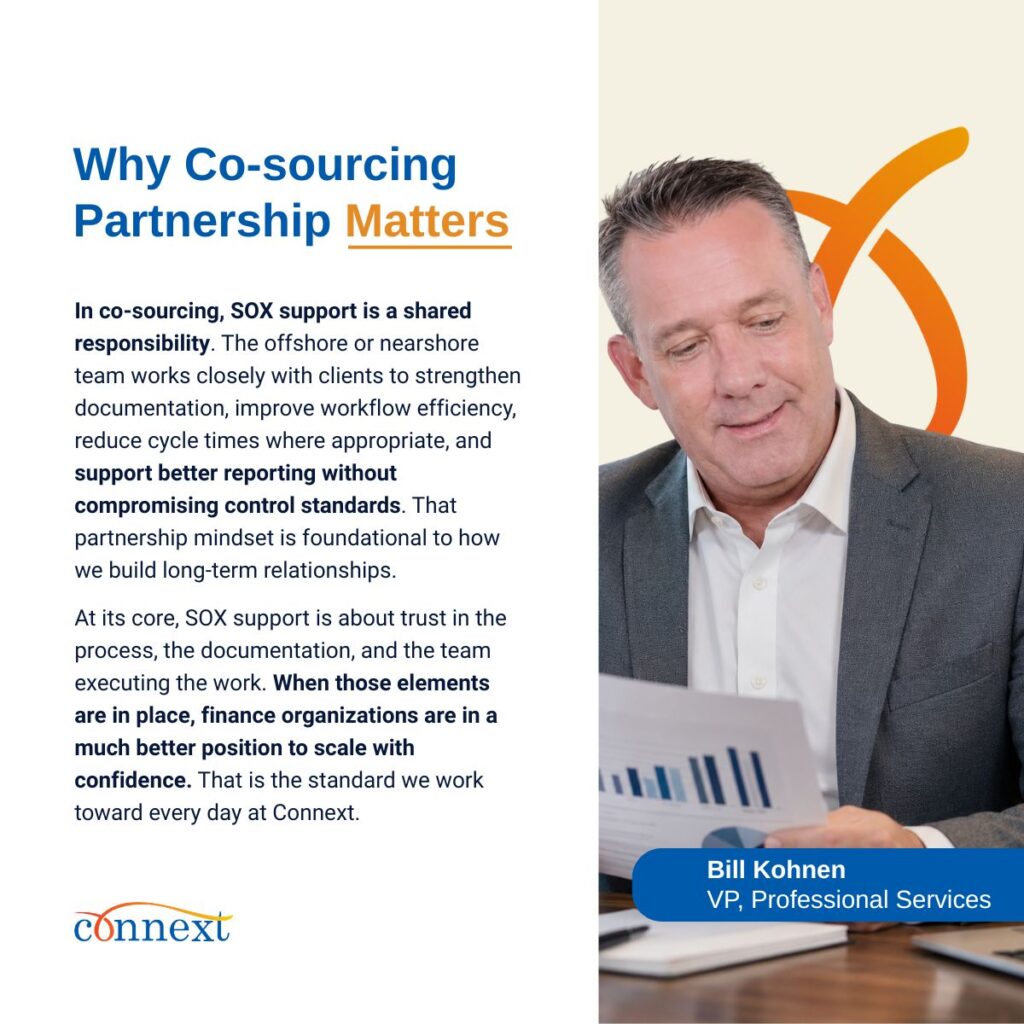
SOX support works best when it is treated as an operational discipline that strengthens both compliance and day-to-day execution. SOX audit and controls, documentation, approvals, and audit evidence only hold up when the team executing the work understands the process and follows it consistently.
The right support model gives finance leaders added capacity without losing control, accountability, or visibility. When offshore or nearshore teams are properly trained, aligned to client workflows, and managed with clear expectations, they can help strengthen SOX readiness and support a more reliable finance operation.
Frequently Asked Questions
SOX internal controls are the policies, procedures, approvals, system safeguards, and documentation practices that help ensure financial reporting is accurate and reliable. They are designed to reduce risk, prevent errors, and support accountability across finance and accounting operations.
SOX controls are specific control activities used to support compliance with the Sarbanes-Oxley Act. These may include approval workflows, segregation of duties, access controls, account reconciliation reviews, journal entry approvals, and documentation standards.
A SOX audit is a review of a company’s internal controls over financial reporting. The goal is to determine whether the company’s controls are properly designed, documented, and operating effectively to support accurate financial statements.
Sarbanes Oxley requirements are rules created to strengthen corporate financial reporting, internal controls, and executive accountability. For finance teams, these requirements often involve maintaining strong control environments, clear documentation, reliable approval processes, and evidence that controls are working as intended.
A SOX compliance audit evaluates whether a company is meeting SOX requirements. It typically reviews internal control documentation, risk control matrices, system access, approval structures, reconciliations, audit evidence, and the consistency of financial reporting processes.
The SOX framework refers to the structure a company uses to manage internal controls, risks, documentation, reporting processes, and audit readiness. A strong SOX framework helps finance leaders create repeatable processes, maintain accountability, and support confidence in financial reporting.
SOX requirements for internal audit often include reviewing control design, testing control effectiveness, validating documentation, identifying control gaps, and ensuring issues are escalated and remediated. Internal audit plays an important role in helping leadership understand whether the control environment is operating as expected.
Documentation is important because it provides evidence that SOX controls are being followed. This may include narratives, flowcharts, risk control matrices, approvals, reconciliations, reports, and audit request support. Without reliable documentation, it becomes harder to prove that controls are operating effectively.
Finance teams can improve SOX audit readiness by maintaining clear roles, following approved workflows, avoiding undocumented workarounds, keeping evidence organized, training teams regularly, and escalating issues quickly. Strong process discipline helps reduce surprises during audit periods.
Outsourced or offshore finance teams can support SOX compliance by following client-approved workflows, using approved systems, respecting authorization hierarchies, supporting audit evidence collection, and maintaining consistent documentation. The client should retain ownership of SOX controls, while the support team helps execute work in a controlled and well-governed way.
Ready to Strengthen SOX-Aligned Operations?
Looking to strengthen finance and accounting operations with a team that supports disciplined execution and control-oriented workflows?
Connect with Connext to learn how we help build high-performing global teams that support finance leaders, reporting integrity, and long-term growth.
Visit https://connextglobal.com/contact/ or email sales@connextglobal.com