


Key Summary
- Offshore tech support helps MPs expand coverage, improve response times, and support clients beyond standard business hours.
- The strongest offshore models reduce cost pressure while preserving quality through training, KPIs, documentation, and clear escalation paths.
- Integrated offshore teams help MSPs scale support capacity without overloading local technicians or pulling senior staff into routine tickets.
- When managed properly, offshore tech support becomes an operational advantage, not just an outsourcing decision.
Managed service providers (MSPs) face a common challenge as they grow. More clients mean more tickets, more after-hours coverage needs, higher response expectations, and more pressure on service managers. Over time, technical leaders can get pulled into day-to-day support issues instead of focusing on client strategy, service improvement, and growth.
Offshore tech support can help MSPs scale support in a more disciplined way. When the team is trained on the MSP’s systems, workflows, documentation, escalation rules, client expectations, and service standards, it becomes a true extension of the operation.
Offshore tech support can improve coverage, create more consistent response times, and add capacity without overloading local teams. It gives technical leaders more time to focus on higher-value work.
What Is Offshore Tech Support for MSPs?
Offshore tech support for MSPs means adding trained technical support professionals in another country like the Philippines, India, Colombia, or Mexico to help manage the day-to-day support work. That can include tickets, troubleshooting, monitoring, documentation, customer communication, and escalation support.
In my experience leading customer service and technical support teams, this looks like an outsourced support desk or help desk outsourcing, but the way it is managed makes a big difference. The best offshore support teams are trained on the MSP’s tools, ticketing system, SLAs, documentation, escalation rules, and customer expectations.
When you set it up the right way, your offshore team becomes part of your support operation. They help you improve coverage, keep service more consistent, and give your local team more time to focus on the work that needs their attention.
Now, I’ll walk through how offshore tech support can help your MSP grow without putting unnecessary strain on your service operation.
1. Offshore Tech Support Helps MSPs Improve Service Coverage
One thing I’ve learned in support operations is that coverage gaps show up quickly. After-hours tickets sit longer than they should, weekend issues wait for attention, and the same technicians get pulled into repeated on-call rotations.
Over time, response times become less consistent, technicians face more pressure, and service managers spend more time solving coverage problems instead of improving the operation.
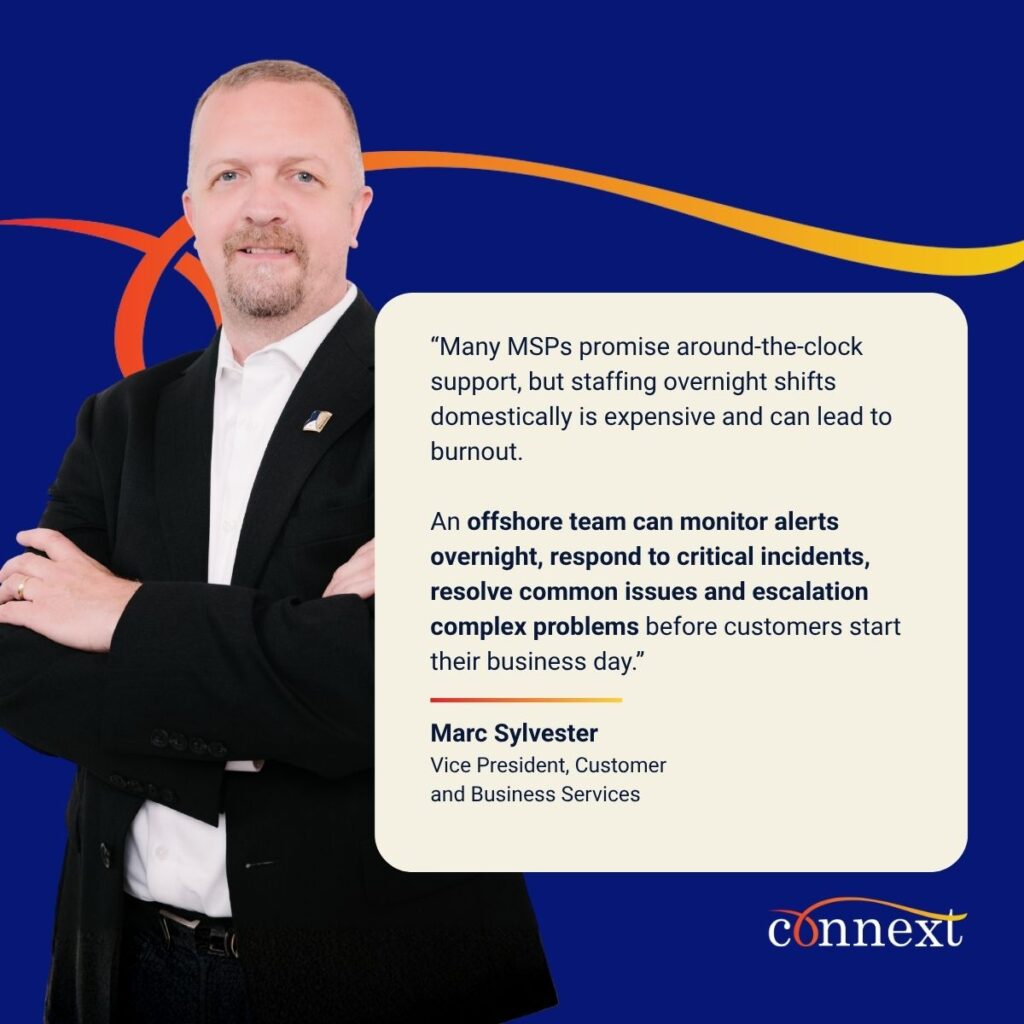
Many MSPs promise around-the-clock support, but staffing overnight shifts domestically is expensive and can lead to burnout. An offshore team can monitor alerts overnight, respond to critical incidents, resolve common issues, and escalate complex problems before customers start their business day.
Many infrastructure changes are also scheduled outside business hours, including server migrations, patch management, backups, and NOC activities. A trained offshore team can support this work during the overnight window when responsibilities, system access, documentation, and escalation procedures are clearly defined.
With clear documentation, defined escalation paths, access to the right systems, and client-led service standards, the offshore team becomes part of the operating model rather than backup support. This creates more consistent coverage, clearer ownership, and less pressure on the domestic team.
2. Offshore Support Reduces Cost While Maintaining Quality
Cost savings matter, but they should not be the whole offshore conversation. For MSPs, the real goal is better capacity, more consistent service, and stronger operational control at a sustainable cost.
A leading IT MSP holding company demonstrated this point by building a custom offshore support team to streamline operations and expand service capacity. The objective was to create a high-performing support model that improved efficiency, strengthened service delivery, and gave the organization more flexibility as client demand grew.
Offshore tech support can help MSPs manage cost pressure by giving them access to skilled support talent in global labor markets. This can make it easier to add coverage, expand help desk capacity, and support more clients without increasing local overhead at the same rate.
Cost only creates value when quality is protected through clear hiring standards, role-specific training, documented workflows, active QA, client-led KPIs, defined escalation paths, and regular feedback. When offshore support is managed as an operating capability instead of a low-cost shortcut, MSPs can improve both capacity and consistency.
3. Offshore Support Improves Ticket Flow
MSPs are often judged before the issue is even fixed. When a client submits a ticket, they want to know it has been received, understood, prioritized, and assigned. Slow acknowledgment creates frustration, even when the technical fix is simple.
That is where offshore tech support can make a real difference. A well-trained team can help review tickets, gather missing information, escalate urgent issues, update clients, and keep the queue moving.
In my experience, many MSP bottlenecks are not caused by a lack of technical knowledge. They are caused by too much work sitting in the same place, waiting for someone to sort it, prioritize it, and move it forward.
A well-managed outsourced support desk creates a cleaner help desk operation through faster first response, better documentation, and clearer escalation paths. Done right, it does not just add people to the queue. It helps the queue work better.
4. Offshore Teams Help MSPs Scale Without Overload
Growth often creates spikes in ticket volume before an MSP is ready to hire a full domestic team. New client onboarding, seasonal demand, and expanded service coverage can quickly stretch existing technicians and service managers.
Offshore tech support gives MSPs a more flexible way to add capacity as demand changes. Building a high-performance outsourced service desk can support faster hiring, provide coverage during peak periods, and help absorb sudden increases in ticket volume without disrupting the existing operation.
This can be especially valuable when an MSP wins a new client and needs to expand support quickly. Instead of pulling senior technicians away from higher-value work or overloading the current team, the MSP can add trained support professionals aligned with its tools, documentation, workflows, and service standards.
The strongest model is not simply about adding headcount. It is about building scalable capacity with clear roles, consistent processes, and defined performance expectations. That gives MSPs more room to grow while maintaining service quality and operational control.
5. Offshore Support Strengthens the Customer Experience
Customer experience in managed services is not only about solving technical problems. It is about how the client feels throughout the support process.
- Was the issue acknowledged quickly?
- Was the technician prepared?
- Was the communication clear?
- Was the ticket updated?
- Was the resolution explained?
- Did the client feel supported?
Offshore tech support can improve the customer experience when the team is trained to operate inside the MSP’s service culture. This requires communication discipline, empathy, documentation habits, escalation judgment, and consistency.
For MSPs, this matters because customer expectations keep rising. Zendesk’s 2026 customer service research notes that 74% of consumers now expect 24/7 customer service, which makes coverage and consistency harder to treat as “nice to have.”
A strong custom tech support team can handle routine issues, keep clients informed, reduce wait times, and create a more reliable support experience. That gives the MSP more room to focus on higher-value client conversations, proactive service reviews, project work, cybersecurity initiatives, and strategic account management.
6. Offshore Support Builds Process Discipline
One concern MSP leaders often have with offshore tech support is knowledge transfer. That concern is valid. If the team is not integrated properly, knowledge gaps can lead to inconsistent service.
From what I’ve seen, the right offshore model can actually improve documentation and process discipline because it forces the MSP to get clear on how support should work. That means documented workflows, ticket categories, escalation rules, client-specific notes, troubleshooting steps, access procedures, and service expectations.
A well-managed outsourced support desk needs structure. It gives local teams clearer documentation, helps new hires ramp faster, and gives service managers better visibility into performance. That is the overlooked value of help desk outsourcing: it creates a more disciplined support operation, not just a larger one.
7. Offshore Support Frees Senior Techs for Higher-Value Work
Many MSPs have senior technicians spending too much time on work that does not require senior-level expertise. That limits the time available for complex troubleshooting, cybersecurity, automation, client planning, and service improvement.
The workload can also take a toll on the team. Auvik’s 2025 IT Trends Report found that 60% of IT professionals experienced some degree of burnout, while 44% said the burden of their work was preventing them from being productive.
Offshore tech support can create better role alignment by assigning routine and repeatable work to trained support professionals.
Offshore teams are particularly effective when processes are well documented and standardized, such as:
- Password resets, where AI is not already in play
- Microsoft 365 or other software administration
- User onboarding and offboarding
- Basic networking issues
- Endpoint troubleshooting
- Routine server maintenance
Success depends on mature documentation, standardized tools, consistent workflows, and clear escalation paths that allow offshore teams to handle well-defined Tier 1 and Tier 2 work while senior technicians focus on issues requiring deeper technical judgment.
8. Offshore Teams Can Support AI-Assisted Service Models
AI is becoming more common in customer service and technical support, but most leaders do not see it running reliably on its own. Only 17% say AI can run independently, while the stronger model is AI supported by human review and dedicated oversight.
For MSPs, AI may help with ticket summaries, knowledge base suggestions, chatbot interactions, routing, or repetitive troubleshooting steps. But there still needs to be human oversight, quality assurance, escalation judgment, and client communication.
Offshore tech support teams can play an important role in this model. They can monitor AI-assisted workflows, review ticket quality, handle exceptions, update documentation, support chatbot training, and step in when automation does not resolve the issue.
This is an important point for MSP leaders: AI can improve speed, but it should not run the support operation on its own. The strongest model combines automation with trained support professionals who understand the client, the workflow, and the service standard.
9. What MSPs Should Look for in an Offshore Tech Support Partner
The offshore model works best when MSPs choose a partner that understands operations, not just recruiting. A strong offshore tech support partner should be able to support role design, recruiting, onboarding, training, workflow integration, performance management, quality assurance, reporting, and scaling.
MSPs should also look for a model that keeps them involved in key decisions. The MSP should retain control over service expectations, KPIs, tools, client requirements, escalation rules, and quality standards.
The right partner should make the support operation easier to manage, not harder. A few practical questions to ask:
- How will the offshore team be trained on our ticketing system and workflows?
- Who manages day-to-day performance?
- How are KPIs reviewed?
- How are escalations handled?
- How is quality measured?
- How is knowledge transferred?
- How quickly can the team scale if ticket volume increases?
- How do we maintain visibility into the work?
Those questions matter because offshore support is not just a staffing decision. It is an operating model decision.
10. When Offshore Tech Support Makes Sense for MSPs
Offshore tech support may be a good fit when an MSP needs to scale support capacity without weakening service quality. That often happens when ticket volume is growing faster than the internal team, clients are asking for broader coverage, local technicians are overloaded with routine support work, or after-hours support is becoming inconsistent or expensive.
It can also help when senior staff are spending too much time on Tier 1 issues, documentation and ticket hygiene need improvement, or the business needs more flexibility during growth periods.
The key is knowing whether the issue is just staffing pressure or a sign that the support model needs more structure.
Connext’s work with an IT managed service provider holding company shows how this can work in practice. Connext helped build a custom offshore support team around the MSP’s operating needs, support expectations, and delivery model, giving the business more scalable support capacity without treating offshore work as a simple handoff. You can read the full IT MSP offshore support case study.
Connext also serves many clients with dedicated teams of more than 50 team members, showing how offshore support can scale when the model is built with the right structure, management, and accountability. This gives clients the ability to expand capacity while keeping visibility, process control, and performance expectations clearly defined.
HELP US REACH MORE PEOPLE
Like what you’re reading?
Add Connext as a preferred source on Google — it only takes a moment and helps more professionals find our content.
- 1 Click Add as preferred source below
- 2 Sign in to your Google account if prompted
- 3 Check the box next to Connext Global to confirm your preference
- 4 Close the tab — you're done. Thank you!
Final Takeaway
Offshore tech support can help MSPs improve service delivery, expand coverage, reduce operating pressure, and create a better customer experience. But the real benefit is operational leverage.
MSPs can build a more scalable support model when offshore technicians are trained, integrated, measured, and managed as part of the service operation. That gives local teams more room to focus on complex work, gives clients more consistent support, and gives the business a stronger foundation for growth.
The MSPs that get the most value from offshore tech support are usually the ones that stay involved. They define the process, set standards, measure performance, and build the offshore team into the way they already serve clients.
Frequently Asked Questions
Offshore tech support for MSPs is a model where technical support professionals in another country help manage client support requests, help desk tickets, troubleshooting, monitoring, documentation, and escalation support.
MSPs use offshore tech support to expand service coverage, improve response times, reduce pressure on local teams, support after-hours demand, and scale help desk capacity more efficiently.
No. Cost savings can be one benefit, but the stronger value is improved capacity, service consistency, process visibility, and scalability. Offshore support works best when quality and accountability are built into the model.
Yes. A well-trained outsourced support desk can help clients receive faster responses, clearer communication, more consistent ticket updates, and quicker resolution for routine issues.
Offshore teams often support Tier 1 help desk tickets, password resets, access issues, basic troubleshooting, ticket triage, monitoring alerts, documentation updates, and escalation coordination.
MSPs can maintain quality in a help desk outsourcing model by using clear workflows, documented procedures, defined KPIs, ticket audits, quality reviews, escalation rules, training, and regular feedback between local and offshore teams.
Not usually. The better model is role alignment. Offshore teams can handle routine and repeatable support work, while local and senior technicians focus on complex issues, projects, cybersecurity, and strategic client needs.
Offshore support gives MSPs flexible access to trained technical talent, making it easier to add capacity as ticket volume grows or client demand changes without overloading the existing team.
Yes. An outsourced help desk for MSP can be trained to work inside the MSP’s existing ticketing system, communication channels, documentation tools, monitoring platforms, and escalation processes.
Offshore tech support succeeds when the team is integrated into the MSP’s workflows, trained on client expectations, measured against clear KPIs, supported with strong documentation, and managed as part of the broader service operation.
Ready to evaluate a more scalable support model for your MSP?
Connect with a Connext specialist to discuss how offshore tech support can help your team improve service delivery, protect quality, and support growth with greater operational control.
Visit https://connextglobal.com/contact/ or email sales@connextglobal.com.