



Key Takeaways
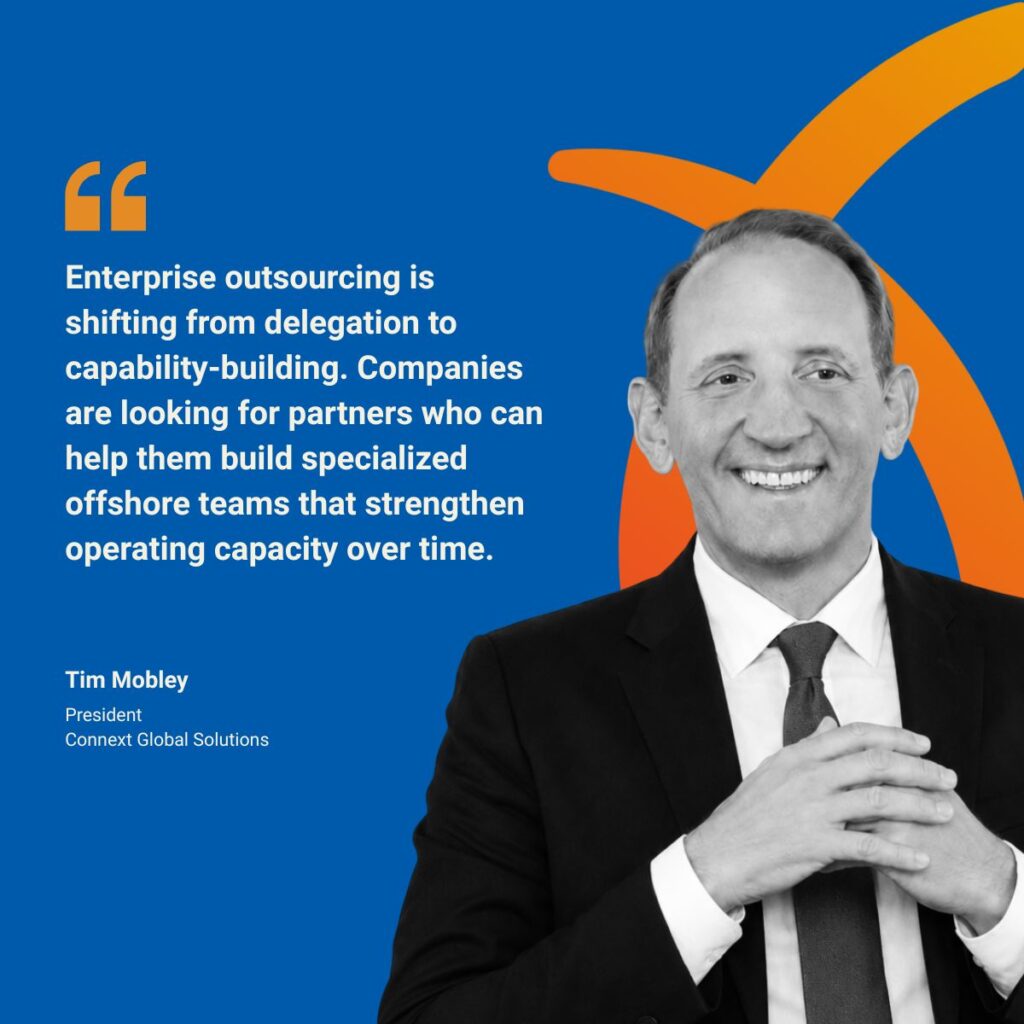
- Enterprise outsourcing is shifting from delegation to capability-building. Companies are looking for partners who can help them build specialized offshore teams that strengthen operating capacity over time.
- Enterprise leaders want access to global talent, but they also want visibility into workflows, ownership of KPIs, clear escalation paths, and the ability to manage performance inside their operating model.
- AI can improve speed and efficiency, but it still requires people to manage exceptions, review quality, update processes, monitor risk, and ensure the work supports the customer, patient, or business outcome.
- Specialized offshore workforce partners create the most value when teams are integrated into the client’s systems, trained on the client’s processes, measured against client-defined outcomes, and managed with long-term operational discipline.
Enterprise companies are rethinking how they scale. The goal is to access the right talent and improve execution without losing control. That is why I believe more companies are moving toward a mature offshore model.
A specialized offshore workforce partner helps build dedicated teams inside the client’s workflows, systems, KPIs, and management structure. The result is greater capacity with clearer visibility, accountability, and ownership.
In this article, I’ll explain why enterprises are moving beyond traditional vendors and adopting this model.
Why the Traditional Outsourcing Category Is Too Narrow
Traditional outsourcing agreements tend to have longer terms, precisely defined services, and limited client control over individual team members and processes. That model worked well when the objective was to move high-volume, routine tasks to markets such as the Philippines, Colombia, and India.
Technology and self-service platforms are now reducing the need for many of those basic tasks. At the same time, companies need smaller, more specialized teams that can adapt as workflows, technology, and customer expectations change.
As work becomes more connected to performance, risk, compliance, and customer experience, enterprise leaders need greater visibility and control. That shift is already showing up in the market: Deloitte reported that 67% of surveyed organizations had adopted outcome-based outsourcing models, up from 45% two years earlier, while PwC found that 94% of companies with siloed or partially integrated structures expect to move toward more horizontal, networked models.
I believe the traditional outsourcing category is too narrow. Enterprise leaders are no longer just looking for a vendor to take work away. They want a specialized, integrated, and client-controlled way to build operating capacity.
What Defines a Specialized Offshore Workforce Partner
I define a specialized offshore workforce partner by how closely the team is connected to the client’s business. The model is about building a dedicated offshore team around the client’s roles, systems, workflows, and performance expectations.
In enterprise offshore staffing, the client stays close to the work by defining priorities, training requirements, KPIs, processes, and quality standards. The partner provides the infrastructure behind the team, including recruiting, Employer of Record support, employment administration, payroll, HR, local management, retention, and workforce continuity.
That division of responsibility matters. The partner manages the local employment and operating structure, while the client retains control over how the work is performed and measured.
The Enterprise Case for Client Control
Enterprise buyers want support without giving up control. That is not micromanagement. When work affects customers, financial controls, compliance, or service quality, the business still owns the outcome.
A New York-based financial technology platform partnered with Connext to build a co-managed offshore operations team. The engagement began with 10 specialists supporting data management and data entry and grew to more than 100 professionals in under a year. Throughout that growth, the client retained control over priorities, processes, KPIs, and performance.
Connext team members identified process gaps, improved workflows, supported training and onboarding, and operated across multiple locations to strengthen continuity and future growth. That is the advantage of a specialized offshore workforce model. It gives enterprise leaders room to scale without sacrificing visibility, flexibility, or control.
Why AI Makes This Shift More Important
Human judgment and oversight were always important, so it is not like the importance has changed. However, how and when humans apply judgment and oversight is clearly changing.
AI-driven processes require more highly trained team members to manage exceptions, review overrides, and step in when the technology reaches its limits.
Companies may need fewer people completing standardized tasks, but they need more capable people supervising AI-enabled workflows and taking ownership of the outcome. This is where a co-managed model becomes more relevant. AI handles routine volume, while specialized teams provide judgment, quality control, exception management, and continuous improvement.
The commercial model matters too. In a traditional BPO agreement, automation may reduce workload without improving client visibility or lowering cost. A co-managed model keeps performance transparent, aligns incentives, and preserves client control.
Where the Model Works Best
Enterprise offshore staffing works best when a company needs scale without removing judgment, accountability, or process control. The model is especially useful in functions where work is repeatable enough to standardize but important enough to require trained people, clear escalation paths, and close coordination with internal teams.
| Business function | Common areas of support | What the work requires |
| Healthcare operations | Revenue cycle workflows, scheduling, administrative coordination, documentation review, patient support, and payer follow-up | Accuracy, HIPAA-aware processes, careful handling of sensitive information, timely escalation, and an understanding of how operational delays affect patients and revenue |
| Finance and accounting | Reconciliations, accounts payable, accounts receivable, reporting support, procurement, and close-related workflows | Process consistency, internal controls, deadline discipline, clear approvals, and strong communication with finance leadership |
| Customer experience | Service coverage, customer inquiries, escalation handling, quality monitoring, and first-call resolution | Speed, judgment, tone, product knowledge, brand awareness, and clear quality standards |
| Technical support | Tiered support, incident triage, account assistance, knowledge-base maintenance, and escalation coordination | Structured troubleshooting, documentation, response discipline, system familiarity, and defined escalation rules |
| AI-assisted operations | Exception handling, output review, quality assurance, workflow monitoring, and model feedback | Human judgment, risk awareness, continuous process updates, and clear ownership when automated outputs are incomplete or incorrect |
| Professional and back-office services | Procurement support, data management, onboarding administration, compliance documentation, and operational reporting | Role-specific expertise, secure workflows, measurable performance, and integration with internal stakeholders |
The strongest use cases have measurable outcomes, documented processes, and clear ownership of exceptions and risk. The value is not simply added capacity. It is a dedicated team that builds knowledge, absorbs volume, and operates with visibility and discipline. When roles are well defined, performance is measured, and the client stays close to the work, enterprise offshore staffing becomes a long-term operating capability.
What Enterprise Leaders Should Ask Before Choosing a Partner
Enterprise leaders should ask more than what the team will cost or how quickly roles can be filled. Price and headcount matter, but in my experience, they do not tell you whether the model will still work after go-live.
The real test comes when the team begins to scale. An expense management software company started with a small Connext pilot and grew to nearly 60 professionals across finance, technology, implementation, and client support. That growth required clear integration, accountability, and client control.
The table below outlines the questions I believe enterprise leaders should ask.
| Question to ask | Why it matters | What a strong answer should demonstrate |
| Will we have visibility into the team’s work and performance? | Leaders cannot manage outcomes through periodic reports alone. | Access to relevant performance data, regular operating reviews, transparent communication, and clear escalation paths. |
| Can the team work inside our systems and processes? | Separate tools and disconnected workflows create delays, duplicate work, and weak accountability. | The ability to integrate the team into the client’s approved systems, workflows, documentation, and communication routines. |
| How will roles be designed and recruited? | A generic job description rarely captures the skills, judgment, and experience required for specialized work. | Role scoping based on actual workflow requirements, structured screening, and client involvement in final selection where appropriate. |
| Who defines training and performance expectations? | The client remains responsible for the business outcome. | Client-led priorities, documented training requirements, agreed KPIs, and a clear process for coaching and performance improvement. |
| How is quality managed? | Productivity without quality can create rework, customer dissatisfaction, financial errors, or operational risk. | Defined quality standards, review processes, feedback loops, root-cause analysis, and ongoing improvement. |
| How are exceptions and risks escalated? | Enterprise workflows often contain cases that cannot be handled through a standard procedure. | Clear decision rights, escalation thresholds, response expectations, and named owners on both sides. |
| How does the partner support retention and continuity? | Replacing trained professionals can disrupt performance and reduce institutional knowledge. | Workforce engagement, local HR support, succession planning, cross-training, and business continuity practices. |
| Who owns performance after go-live? | Some providers focus heavily on recruitment but provide limited operational support once the team is in place. | Clear accountability for workforce support, operating reviews, issue resolution, and continuous alignment with the client. |
| Can the model scale without reducing control? | Growth can expose weak processes, unclear ownership, and inconsistent training. | Standardized workflows, management capacity, repeatable onboarding, and the ability to expand while preserving client oversight. |
| How flexible is the operating model? | Roles, priorities, and technology will change as the business evolves. | The ability to adjust team structure, responsibilities, workflows, and performance measures without forcing the client into a rigid model. |
A strong enterprise offshore staffing partner should be able to explain how the team will be integrated, supported, measured, and improved over time. The success of the model depends less on where the team sits and more on how the work is managed, how accountability is shared, and how closely the team operates within the client’s business.
How to Structure the Partnership for Long-Term Success
A strong offshore partnership needs more than a staffing plan. It needs clear ownership, communication, and accountability.
Governance should define the outcomes that matter, including quality, accuracy, turnaround time, responsiveness, and escalation management. The partner supports recruiting, local employment, workforce continuity, and management infrastructure. The client stays close to workflows, KPIs, priorities, and performance.
That balance is what makes co-management work. The team gets the support it needs without the client losing control.
Cost matters, but it should be evaluated alongside talent quality, process integration, management support, and scalability. The Connext pricing calculator can help estimate the investment for different roles and team structures.
Final Takeaway
Enterprise companies should build operating capacity without losing control of the outcome. The best offshore teams are embedded in the business, measured against the client’s KPIs, and managed around the client’s systems and priorities. They can support AI-enabled workflows, but human judgment still matters for quality, exceptions, and risk. That is the real distinction.
Build global operating capacity without giving up control.
Connect with a Connext specialist to design an offshore workforce partner model built around dedicated talent, client-led KPIs, operational visibility, and long-term scalability.
Visit connextglobal.com/contact/ or email sales@connextglobal.com.
Like what you’re reading?
Add Connext as a preferred source on Google — it only takes a moment and helps more professionals find our content.




You're done. Thank you!