

Key Takeaways
- AI is rewriting jobs more than cutting them. Workday found 40% of leaders expect AI to help them get more from their current people, while only 28% expect it to reduce headcount.
- The skills that matter are shifting from basic prompting to hands-on work like automating workflows, which raises the bar for hiring and training.
- A 13-point gap separates workers who know what skills they need from those whose employers help them build those skills, and offshore teams feel this gap as much as domestic ones.
- When evaluating an offshore partner, leaders should look past headcount and rate cards and ask how the partner upskills people, who owns training, and how good people keep growing.
Artificial intelligence (AI) is changing how businesses think about hiring, training, and managing their people. As AI takes on more routine tasks, companies need employees who can adapt to new workflows, make sound decisions, and handle work that still requires human judgment. For business leaders, the challenge is figuring out what skills their teams need today and how to prepare them for what's coming next.
When I ran healthcare operations, including a dental group of about 200 employees, I learned that good results depend on hiring and training the right people, giving them clear processes, and managing them well. AI hasn't changed that principle, but it is changing the skills businesses need to look for and develop.
What Is the Workday Data Actually Telling Leaders?
Phil Willburn at Workday made the same point in the new Workday Global Workforce Report, and it stayed with me all week. A few numbers from the report are worth sitting with:
- 40% of business leaders expect AI to help them get more out of the people they already have. Only 28% expect it to cut headcount.
- Demand for basic AI skills like simple prompting fell 25% after peaking in January. Demand for hands-on skills like automating workflows climbed 51%.
- 79% of workers know what skills they need. Only 66% say their employer helps them build those skills.
These developments reinforce a point explored in the hidden workforce behind AI: “AI is not eliminating work as much as it is changing where the work happens.” Workday’s numbers say the same thing from a different angle. Leaders aren’t planning to replace their teams. They’re planning to ask more of them.
The Connext Global 2026 AI Oversight Report reinforces this perspective. Only 17% of U.S. adults who use AI at work said AI can operate with minimal human involvement. As AI takes on more tasks, human work increasingly centers on review, judgment, and managing the exceptions AI cannot handle independently.
Why Does the 13-Point Skills Gap Matter Most?
I’d focus on the gap in that last number. Most workers already know where their jobs are heading. They just aren’t getting enough help to get there.
The mistake many companies make is assuming this shift stops at their own office. It doesn’t. Your team in Manila or Bogotá feels the same pressure your team in Chicago does. Their workflows are changing too, and they need the same support to keep up.
I wrote about this at the enterprise shift toward specialized offshore workforce partners. “Human judgment and oversight were always important, so it is not like the importance has changed,” I said then. “However, how and when humans apply judgment and oversight is clearly changing.”
Handling the exceptions and overrides AI creates takes a more highly trained person. If your offshore team isn’t part of your training plan, the gap doesn’t close. It just moves overseas, where it’s harder to see.
Why Does Hiring the Right People Matter More With AI, Not Less?
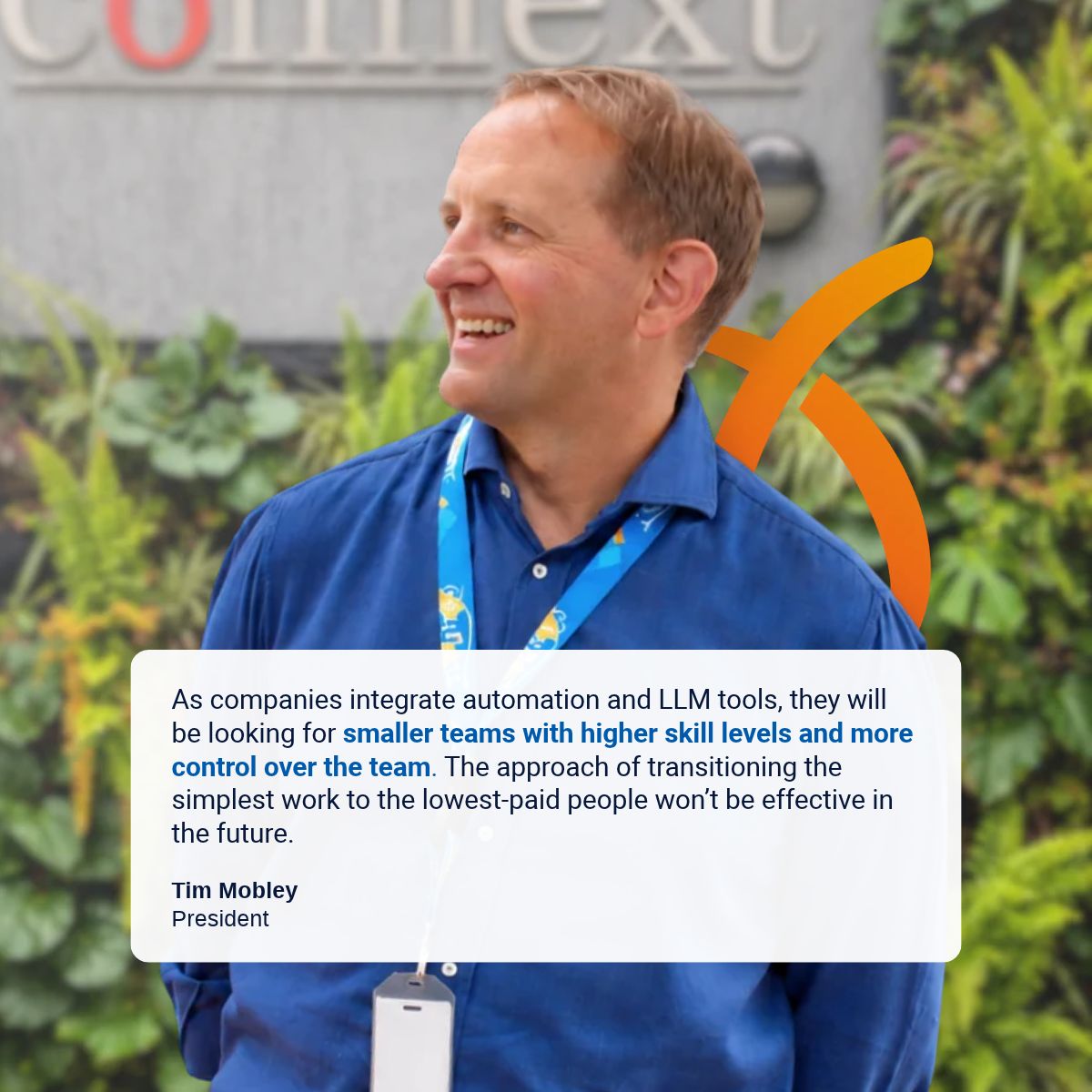
With AI, you don’t just need people. You need the right people, and you need to keep helping them grow. What we have learned at Connext is simple. When things go wrong in an operation, the cause is almost always the same short list: the wrong people, a lack of training, bad processes, or a lack of management. AI doesn’t remove any of those. It exposes them faster.
In my post on human-in-the-loop AI, I put it this way: “Technology does not remove the need for structure. It raises the need for it.” The same goes for talent. When AI handles the routine volume, the work left over is the work that needs judgment. You can’t hand that to someone who was hired for a task that no longer exists and never trained for the one that replaced it.
So, the hiring bar goes up, and the training commitment goes up with it. You need people who can learn, and you need a system that keeps teaching them.
What Should Leaders Ask an Offshore Partner About AI Readiness?
When you evaluate a partner, look past the headcount and the rate cards. Price and speed to hire matter, but they don’t tell you whether the team will still perform a year from now, after your workflows have changed on several occasions.
The question leaders should ask is how the partner keeps people current. Start with these three:
- How do you upskill people when the work changes? A good answer names specific programs, not a promise to “support development.”
- Who owns training when our workflows change? In a co-managed model, you own your processes and standards, so you define what the team needs to learn. The partner should make sure the time, structure, and support exist for them to learn it.
- How do you keep good people growing so they stay? Every trained person who leaves takes your process knowledge with them. Retention is part of AI readiness, not separate from it.
If a partner can’t answer these clearly, you’re buying capacity for today’s work and nothing more.
How Is Connext Helping Offshore Teams Keep Up?
We built training designed for offshore teams at Connext for this reason, and it includes AI readiness. It runs through Connext University, our internal learning hub with four academies covering management, business, professional, and life skills. We commit a significant portion of our monthly revenue to training and development, because I’ve seen what happens when companies treat training as optional.
At our 2026 Connext Leadership Summit, we paired an AI training session with an AI-assisted hackathon. Our leaders didn’t just hear about the tools. They used them on real problems, together.
The bigger lesson applies to any team, though, offshore or not. The companies that do well with AI won’t be the ones that cut the most. They’ll be the ones that hired the right people and helped them keep up.
Final Takeaway
AI is changing the work inside every team, including the ones you’ve built offshore. The companies that get the most from it treat hiring and training as part of their AI strategy, not a separate HR task.
Hire people who can learn. Give training a clear owner when workflows change. Keep good people growing so the knowledge they build stays in your business. Technology moves fast, but people still decide whether it works, and they deserve the same investment as the tools.
Build an Offshore Team That Grows With Your Business
Connect with a Connext specialist to design a co-managed team built around the right people, client-led training, and the support they need to keep up as AI changes the work.
Visit connextglobal.com/contact or email sales@connextglobal.com.
Like what you’re reading?
Add Connext as a preferred source on Google — it only takes a moment and helps more professionals find our content.




You're done. Thank you!