



Key Takeaways
- Outsourcing in 2027 rewards smaller, higher-skilled teams with more client control, not the lowest-cost seats.
- AI changes which people you need. Critical thinking, problem solving, and strong management matter more than headcount.
- Co-management gives companies the control of a global capability center without the investment and administrative burden of building one.
What happens to outsourcing when AI starts doing the work that companies used to outsource? It’s a question more business leaders should be asking as we head into 2027. For years, outsourcing was built around moving high-volume, repetitive work to lower-cost locations. Now, as automation and large language model (LLM) tools take on more of those tasks, the need for large teams doing routine work is changing. Companies will increasingly need smaller, more skilled teams that can handle exceptions, review quality, solve problems, and make decisions that still require human judgment.
The future of the BPO industry will depend on how companies respond to this shift. Having spent years managing healthcare operations and building Connext, I've seen how much difference the right people and collaborative management can make. Offshore teams perform best when they're treated as part of the business, with clear expectations, direct involvement from leadership, and accountability for results. As AI changes the work these teams do, this approach will matter even more.
What Will Be Fundamentally Different About Outsourcing in 2027?
The biggest change is the type of work going offshore and the level of control companies expect over it. As companies integrate automation and LLM tools, they will be looking for smaller teams with higher skill levels and more control over the team. The approach of transitioning the simplest work to the lowest-paid people won't be effective in the future.
A few years ago, most outsourcing conversations focused on cost. What work could be moved? Where were the lowest rates? How many people would it take? The model worked well for routine tasks like data entry, basic customer support, and high-volume calls. But as technology and self-service tools handle more of this work, the conversation is starting to change.
Deloitte’s 2024 Global Outsourcing Survey found that 83% of executives already use AI in outsourced services. Cost still matters, but access to skilled talent, flexibility, and greater control are becoming just as important. As AI takes on routine tasks, people are left handling the exceptions and decisions that require judgment. Choosing the lowest bidder for this work comes with real risks to quality and performance.
Will Companies Need Fewer Offshore Employees but More Specialized Ones?
During any period of change, some companies will need more people and some companies will need fewer people. However, in either case, the majority of the roles will require different skills with better critical thinking and problem-solving capabilities. As important as the type of people companies should be hiring, is a clear understanding of the system. That is, it not only takes the right people; it takes the right training, systems, processes, and management to be successful.
The mistake many companies make is assuming AI simply reduces headcount. In practice, it changes the job. A billing specialist who used to key in claims now reviews the denials an AI tool flags and decides which ones to appeal. An accounts payable clerk who used to match invoices now works the exceptions the matching tool can't resolve.
Both roles need someone who can think, not just follow a script. According to the World Economic Forum's Future of Jobs Report 2025, seven out of 10 employers consider analytical thinking an essential core skill, and 63% name skill gaps as the biggest barrier to transforming their business.
Hiring is only the first part. The right people need the right system around them: training, processes, tools, and management. At Connext, custom recruiting starts with the client's actual role requirements, and ongoing development through Connext University keeps team members and managers growing as the work changes. Our co-management approach brings everything together, giving clients control over their team's daily work and performance while Connext handles local management and operational support.
Will 2027 Be the Year Companies Stop Treating Offshore Talent as a Commodity?
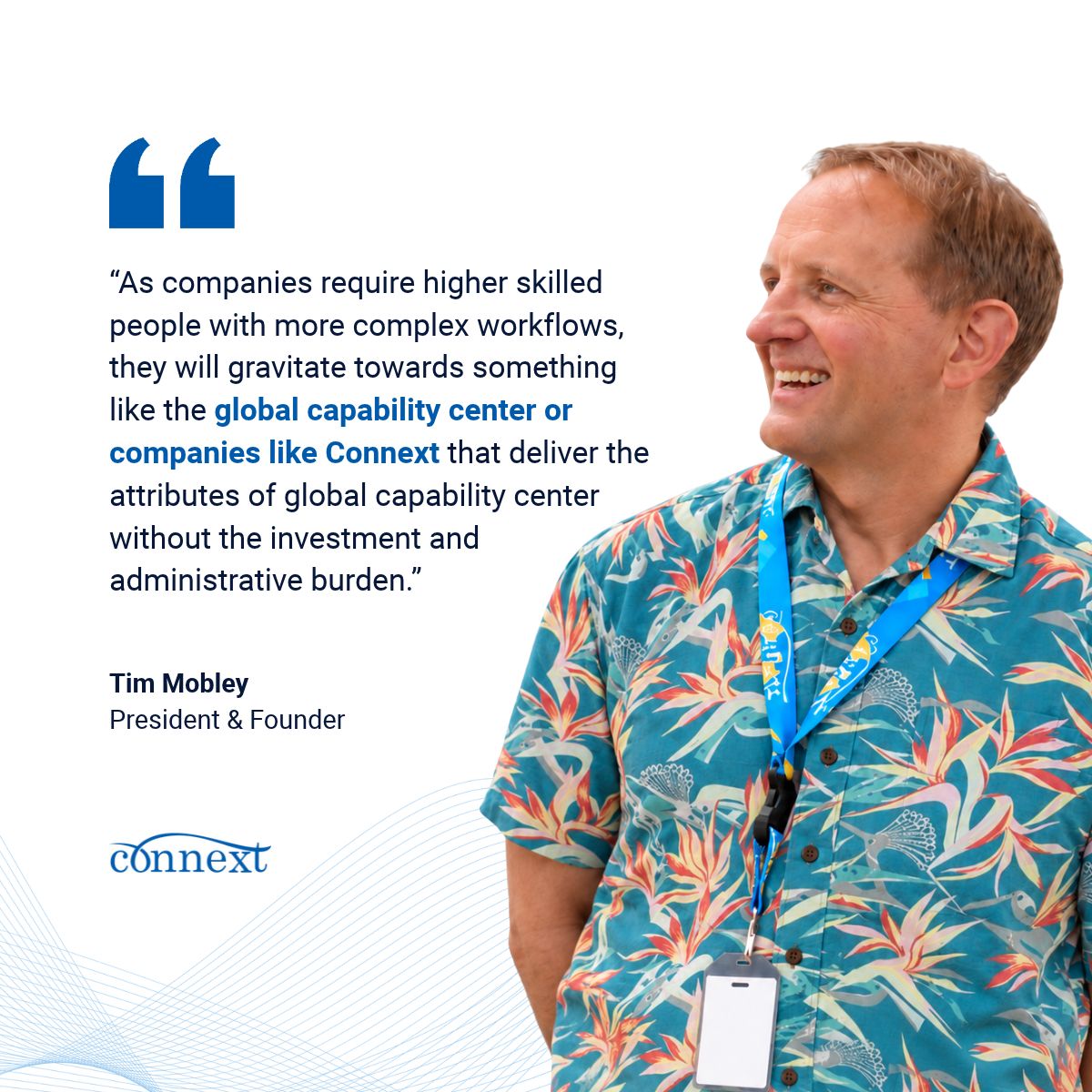
Large multinationals began establishing global capability centers to control not just the quality of the people, but also the larger system in terms of training, systems, process, and management. As companies require higher skilled people with more complex workflows, they will gravitate towards something like the global capability center or companies like Connext that deliver the attributes of global capability center without the investment and administrative burden.
Global capability centers (GCCs) grew because big companies wanted control over the whole system, not just a lower rate. India alone had crossed 1,760 GCCs by the end of 2025, according to Zinnov's review of India's GCC landscape. The same research shows mid-market companies now run more than 480 of those centers, about 27% of the total.
In other words, control is no longer only an enterprise priority. Building a GCC, though, means setting up entities, facilities, payroll, HR, compliance, and local leadership. For most mid-market companies, the investment and administrative burden don't make sense.
This is the gap I wrote about in the enterprise shift from outsourcing vendors to specialized offshore workforce partners. Companies want the attributes of a GCC, including dedicated people, client-led processes, and real visibility, without carrying the full setup themselves.
Where Will Traditional, Hands-Off Outsourcing Models Start to Struggle?
The challenge starts with recruiting. Experienced and highly skilled workers are unlikely to sit in chairs outside in front of a recruiting office at a mall. Then, after finding candidates, the whole process has to be different. Change is difficult. The second challenge is management. I see first hand how hard it is for someone who's worked in a call center to transition to managing a diverse team of skilled individuals. Facilities, payroll, employment, etc. are largely commodity services and not a significant transition.
Traditional models were built for volume hiring. Walk-in recruiting, standard assessments, and fast seat fills work when the job is simple. Experienced accountants, developers, and healthcare specialists don't find jobs that way. You have to go find them, understand the role, and give the client a real say in who joins the team.
Management is the harder transition. A supervisor running a large call center floor manages schedule adherence and handle time. A manager of skilled professionals manages judgment, context, and quality. Those are different jobs.
Hands-off models also create a visibility problem. When the provider controls the people, the process, and the reporting, the client often sees a problem only after it has already hurt the business. I go deeper on this in co-management vs. outsourcing.
Notice where the line falls. Facilities, payroll, and employment are commodity services, and a partner should take them off your plate. The people, the process, and the management decisions are where you need to stay involved.
How Does Co-Management Keep Clients in Control?
Co-management splits ownership clearly: the client runs the work, and the partner runs the operating environment that keeps the team performing.
Here is how I describe it to clients. The client is charting the course and flying the plane. Our job is to make sure there's a solid runway and reliable ground crew in terms of recruiting, infrastructure, HR support, and the operating discipline that keeps the team performing.
In Connext's co-management model, every client works with a dedicated Service Delivery Manager. The manager checks in with team members daily, handles HR matters, reports on the KPIs the client sets, and runs recurring business reviews with the client.
| Area | The client owns | Connext supports |
| Priorities and outcomes | Goals, KPIs, and quality standards | Measuring and reporting KPIs as the client directs |
| Team selection | Interviewing and approving every hire | Sourcing, screening, and first-round interviews |
| Workflows and systems | Processes, tools, and business decisions | Onboarding, equipment, and Level 1 IT support |
| Performance | Defining what good work looks like | Daily check-ins and coaching as the client directs |
| Employment | Incentive and bonus decisions | Payroll, benefits, HR, and local labor requirements |
As offshore staffing trends shift toward more specialized teams and greater client control, clear responsibilities will become even more important. The future of BPO will depend on how well companies and their partners work together to deliver results.
How Will the Manager's Role Change as Teams Mix AI, Automation, and People?
In any situation, managers have to understand what is actually happening and the workflow to be effective. As workflows incorporate more AI and automation, the technical expectations of managers will increase. Then, with all new technologies and processes, things don't go exactly as planned. This means managers will need stronger critical thinking, problem solving, and change management skills.
If humans are involved, human judgement will be required. The exact way it matters varies of course, it can be troubleshooting, managing escalations, talking to people, etc. Then, the more interesting area is the rapidly emerging resistance to all things AI. Companies and managers are being forced to adapt to this or choose not to.
Managers have always mattered more than most companies admit. Gallup estimates managers account for at least 70% of the variance in employee engagement across business units. Add AI to the workflow and the job gets harder. A manager now has to understand where the AI sits in the process, what its common errors look like, and when a person needs to step in.
The resistance to AI is real, and managers feel it first. Pew Research Center found half of U.S. adults are more concerned than excited about AI in daily life, and a majority want more control over how it's used. Employees and customers bring those feelings to work. Good managers address them directly instead of pretending they aren't there.
Human judgment and oversight were always important. What's changing is how and when people apply them. As I explained in the hidden workforce behind AI, it takes a more highly trained team member to manage the exceptions and overrides AI-driven processes create.
What Should CFOs and CEOs Evaluate Beyond Hourly Rates?
Two important lessons I've learned are directly applicable to this question. First, decision makers need to think about what they're trying to accomplish and understand what they're buying. To use an extreme example, people don't buy motorcycles when they need to move things even though they're lower cost and greater savings than a truck. It's much harder with staffing and especially staff in a different country with a different cost environment.
Second, work with someone you're comfortable treating as a partner. People are not commodities. The right person has to be in the right job. And, even when it is the right person, they need the right training, systems, tools, and management to be successful. Those with the worst outcomes assume they know the most about everything instead of working collaboratively with their offshore team to accomplish their objectives.
Hourly rates are easy to compare. Outcomes are not. Before signing anything, I'd want clear answers to five questions:
- What are we actually buying: capacity, capability, or both?
- Who chooses the people on our team, and what happens when someone is in the wrong role?
- Who trains the team, and who owns the process documentation?
- Who manages the team day to day, and how do we see performance in real time?
- How will this team adapt as AI changes the workflow?
A good partner answers all five in detail. Connext's service model is built around dedicated team members who work inside the client's processes and systems, with the client involved in hiring, training, and KPIs from day one.
Final Takeaway
Outsourcing in 2027 isn't about moving simple work to the cheapest location. AI is taking over much of the simple work. What's left needs skilled people, a strong system around them, and leaders who stay involved.
What we have learned over the years is consistent. If you hire the right people, they work in the right processes, you train them well, and you manage them, you get good outcomes. Co-management lets you do all four while keeping control of your team, your priorities, and your results.
Is Your Offshore Strategy Ready for 2027?
As AI reshapes workforce needs, business leaders must prioritize skilled talent, operational control, and accountability over headcount. Connext helps companies build flexible, co-managed offshore teams that combine specialized expertise, transparent pricing, and client-led oversight to support sustainable growth.
Visit https://connextglobal.com/contact/ or email sales@connextglobal.com.
Like what you’re reading?
Add Connext as a preferred source on Google — it only takes a moment and helps more professionals find our content.




You're done. Thank you!