




Key Takeaways
- Patient experience starts at every touchpoint. Scheduling, billing, and support teams directly influence patient trust and loyalty.
- Quality depends on coordination. Shared goals, clear communication, and mutual accountability help teams deliver consistent outcomes.
- Co-management strengthens operational control. Client-led training, performance standards, and oversight help offshore teams integrate effectively.
- Long-term success requires shared investment. The right talent, ongoing training, and collaboration are essential to building reliable healthcare teams.
Picture a patient with a new cancer diagnosis. She is frightened, she has a dozen questions, and the first person she will speak with at your organization is not a physician. It is the person who answers the phone to schedule her first appointment.
That call is a critical moment, whether anyone labels it one. It tells her whether she is in good hands. Healthcare delivery is a relationship at every touchpoint in the patient journey, and the front desk, the scheduler, and the billing team are all part of it.
What the Patient Data Says
Accenture’s patient experience benchmark surveyed 10,000 U.S. healthcare consumers and found that trust is the strongest predictor of loyalty. Of the patients who trust their provider, 91% say they will definitely stay. Only 57% of patients say they trust their providers. Only 44% had their issue resolved on the first contact with customer service. The report also found that moving from very engaged to somewhat engaged cut loyalty by more than 50 percentage points on several measures (Payerchin, 2026).
The danger is not mostly angry patients. It is the patient in the middle who is somewhat satisfied and has nothing holding her to you. Whoever handles her call, her scheduling, and her bill is shaping that outcome every day.
Quality Comes From How People Work Together
Research on healthcare teams points the same way. Gittell et al. (2000) studied 338 care providers and 878 joint replacement patients across nine hospitals. They measured what they called relational coordination: frequent, timely, accurate communication, plus problem-solving, shared goals, shared knowledge, and mutual respect. Higher relational coordination was associated with better quality of care, less postoperative pain, and shorter hospital stays.
A later study surveyed 747 staff nurses. As relational coordination between nurses and other providers rose, the nurses reported fewer adverse events, such as hospital-acquired infections and medication errors (Havens et al., 2010). Both studies looked at clinical teams. I believe the same logic applies to the teams that schedule, verify, bill, and collect. Those teams also depend on shared goals, shared knowledge, and mutual respect, and they get worse when those are missing.
Outsourcing Works the Same Way
Outsourcing is usually sold on price. The relational coordination research suggests that the real question is whether two organizations can coordinate as well as one. In a systematic review of the empirical studies published from 1991 to 2019, Bolton et al. (2021) describe work that is increasingly complex and interdependent, which requires coordination across roles, disciplines, and organizations. The evidence they reviewed supports the theory: shared goals, shared knowledge, and mutual respect support the frequent, timely, accurate communication that lets people coordinate across those boundaries. A client and an outsourcing partner are two organizations that must coordinate every day. The same conditions apply, and I would argue they decide whether the arrangement works.
What Co-management Means
In a co-management model, Connext handles the employer-side backbone, including the legal entity, payroll, IT, and facilities. In Herzberg’s terms, these are hygiene factors: conditions that prevent dissatisfaction but do not by themselves motivate people (Herzberg, 1968). The client directs the work and builds the team’s knowledge of its own patients, systems, and standards. The people on that team belong to a team, are trained on the client’s business, and are accountable for results that the client defines. That is how relational coordination gets built, and it takes time and effort from both sides.
How Healthcare Leaders Can Measure Operational Quality
Quality becomes easier to manage when teams agree on what good performance looks like and review it consistently. For patient-facing and revenue cycle teams, it is important to focus on five operational measures:
- First-contact resolution: How often are patient questions or requests resolved without additional calls or transfers?
- Scheduling accuracy: Are appointments booked correctly, with the necessary patient information and scheduling requirements confirmed?
- Billing inquiry resolution: How quickly and accurately are billing questions addressed, and how often do unresolved issues require additional follow-up?
- Training completion: Are employees completing required training and demonstrating that they understand the client's systems, workflows, and standards?
- Escalation turnaround time: How quickly are complex or sensitive issues directed to the appropriate person for resolution?
These measures become more useful when both the healthcare organization and its outsourcing partner understand who owns each outcome.
In a co-management model, the client defines the performance standards and directs the work, while Connext provides operational support, ongoing coordination, and accountability for its responsibilities. The goal is to build a team that communicates effectively, identifies problems early, and delivers a more consistent patient experience.
Why These Arrangements Fail
When offshore healthcare teams struggle, the cause is rarely only the vendor. The recurring drivers on the client side include too little investment in training, recruiting that does not match the work, and resistance from operational stakeholders who never accepted the team as their own. Vendors have their own failures. The two sets of causes feed each other.
Here is what we are doing about the first of those, training. This quarter we are building client-specific training for the managers who run four of our largest revenue cycle accounts. It extends our core curriculum into each client’s own content and is built around the specific roles those managers hold. The managers and directors complete it themselves before it reaches their teams. Our general training teaches the work. The client-specific layer teaches the account. We expect client performance to improve as the managers apply it, and we will track the results.
Who It Is For
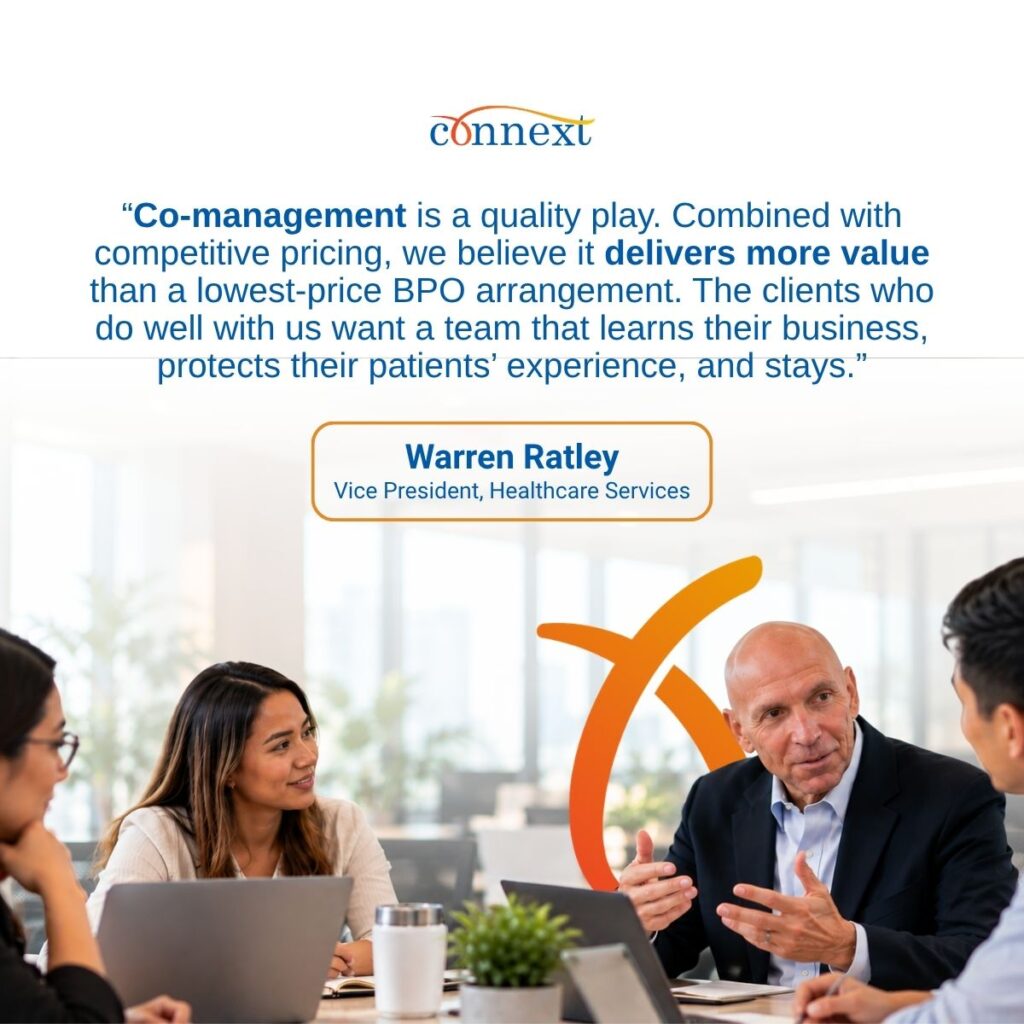
Co-management is a quality play. Combined with competitive pricing, we believe it delivers more value than a lowest-price BPO arrangement. The clients who do well with us want a team that learns their business, protects their patients’ experience, and stays.
If you lead a physician enterprise, a health system, or a revenue cycle operation, ask yourself one question about your current model. When a patient calls, does the person who answers know your patients, your systems, and your standards as well as you do?
Final Takeaway
Co-management offers a way to expand operational capacity while maintaining direct control over quality, training, and performance standards. Healthcare teams become better integrated, more accountable, and equipped to deliver consistent results by combining the healthcare organization's oversight with a partner's recruiting expertise, infrastructure, and operational support. The strongest partnerships are built on shared responsibility, continuous improvement, and a commitment to protecting the patient experience at every touchpoint.
Build a healthcare team that understands your patients, processes, and standards.
Connect with a Connext specialist to explore a co-managed approach built around quality, accountability, and long-term performance.
Visit https://connextglobal.com/contact/ or email sales@connextglobal.com
Like what you’re reading?
Add Connext as a preferred source on Google — it only takes a moment and helps more professionals find our content.




You're done. Thank you!