



Key Takeaways
- Tier 1 work is becoming more complex. As AI and self-service absorb routine interactions, the line between Tier 1 and Tier 2 is increasingly difficult to define.
- Support metrics need to evolve. AHT and volume still matter, but FCR, repeat contacts, QA, and customer satisfaction provide a fuller picture of performance.
- Frontline hiring needs a different skill profile. Problem-solving, critical thinking, empathy, and adaptability are becoming baseline requirements.
- Automation raises the value of capable people. As AI handles simpler work, human teams become increasingly important for complex situations and customer recovery.
- The operating model has to keep pace. Roles, training, KPIs, QA, escalation paths, and career development should evolve alongside the work.
Tier 1 used to be predictable: password resets, order status, appointment confirmations, basic billing. Support teams were built around that work, with an emphasis on volume, speed, and consistency.
AI and self-service are now taking more of those routine interactions out of the queue. What reaches an agent increasingly requires context, judgment, and problem-solving, making the traditional line between Tier 1 vs. Tier 2 support harder to draw.
When escalations rise or customer satisfaction slips, the problem may not be individual performance. The support model itself may no longer reflect the work the frontline is being asked to solve.
What Actually Reaches the Frontline Now
Let me put the shift in practical terms. When AI and self-service take over password resets, order status, basic billing questions, and simple troubleshooting, the team member receives the exceptions: emotionally charged situations, ambiguous problems, and cases where multiple issues intersect and need to be escalated.
What companies underestimate is how much the easy volume used to balance the difficult work. A Tier 1 agent handling 40 contacts might have faced 5 difficult ones and 35 routine interactions. Remove those 35, and the difficult contacts become the job. And by the time those customers reach an agent, many have already tried self-service and are frustrated.
The frontline role is becoming a different job. It requires more judgment, resilience, and problem-solving, which means outsourced Tier 1 support must evolve too. Companies need to rethink how these teams are hired, trained, measured, and supported as the work becomes more complex.
The Metrics No Longer Tell the Whole Story
Traditional Tier 1 metrics still matter, but they no longer tell the whole story. Average handle time (AHT), ticket volume, and cost per interaction are useful for understanding operational efficiency. However, as automation handles more routine customer interactions, the nature of the work reaching Tier 1 agents changes.
Agents increasingly need to manage more complex issues, investigate problems, exercise judgment, and demonstrate empathy. In that environment, optimizing speed and volume alone can create unintended consequences: rushed resolutions, repeat contacts that hurt NPS, and declining customer satisfaction.
What I have seen over the years is that teams perform on the scorecard they are given. If the scorecard rewards closing fast, agents will close fast, even when the issue needs another ten minutes of investigation. The customer calls back, the contact counts twice, and the cost per interaction that looked efficient on the dashboard has quietly doubled.
The shift is toward measuring how effectively agents resolve customer problems, not just how quickly they process interactions. First contact resolution (FCR) in call center operations, repeat-contact rates, QA results, and customer satisfaction should carry at least as much weight as handle time.
The Skills That Matter Have Changed
As frontline work becomes more complex, the skill profile has to evolve with it. Problem-solving, critical thinking, and attention to detail are now baseline requirements for the frontline, not traits you hope to develop by Tier 2. Soft skills such as empathy and tone also come into play when handling complex situations that call for a more customer-centric approach, including apologizing for service interruptions or quality issues.
A customer facing a billing error on top of a service outage does not need a faster script. They need someone who can untangle both issues, explain what happened, and take ownership of the next step. AI can improve speed and scale, but situations like these still depend on human judgment.
Connext’s 2026 AI Oversight Survey found that only 17% of U.S. adults who use AI at work said it can operate with minimal human involvement. An AI customer service agent may handle a straightforward request quickly, but when the issue falls outside the expected path, people need to step in with the context and judgment to resolve it without making the customer start over.
Hiring for the Job as It Exists Today
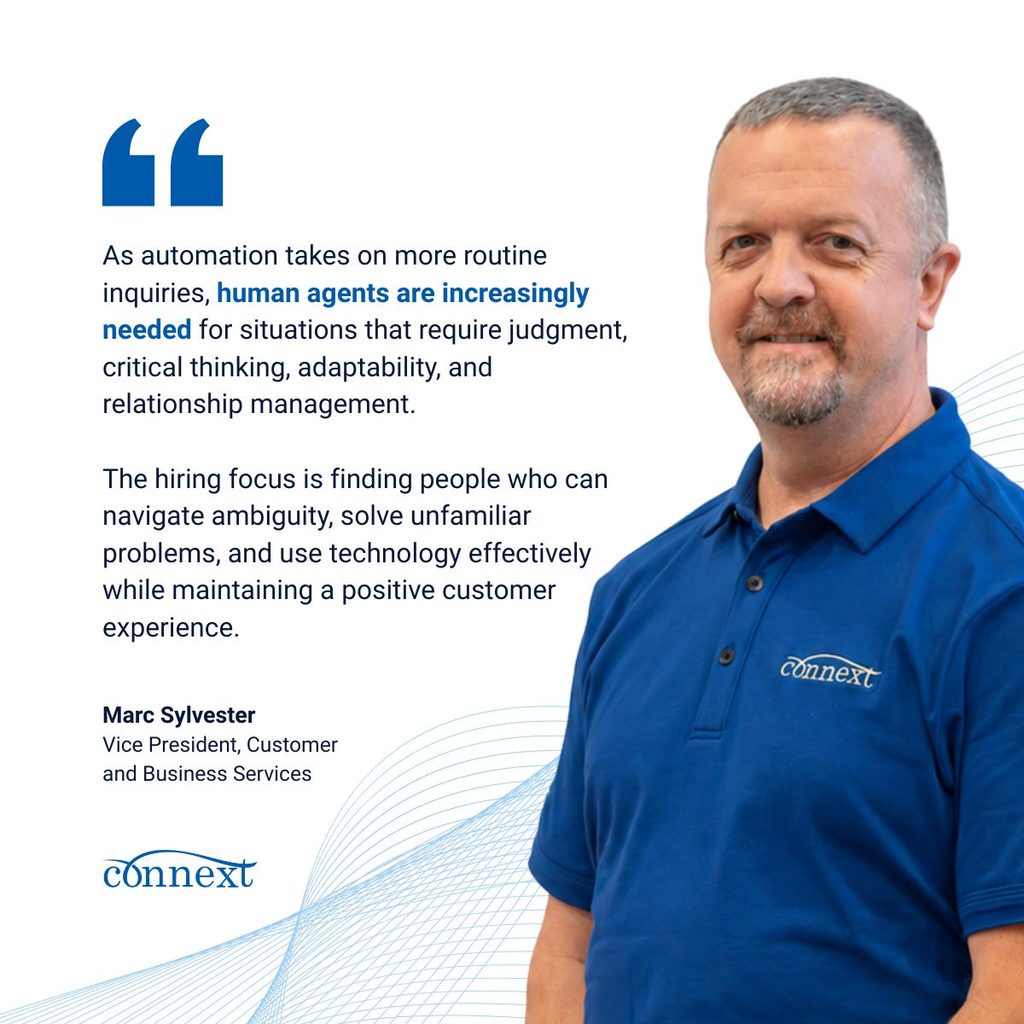
As automation takes on more routine inquiries, human agents are increasingly needed for situations that require judgment, critical thinking, adaptability, and relationship management. The hiring focus is shifting from finding people who can efficiently follow a process to finding people who can navigate ambiguity, solve unfamiliar problems, and use technology effectively while maintaining a positive customer experience.
Five or ten years ago, a strong Tier 1 candidate was someone who could learn the system quickly and stay composed under volume. Today, I look for someone who asks good questions, recognizes when a problem is bigger than it first appears, and is comfortable working alongside AI tools rather than behind them. Customer satisfaction starts with hiring people who can solve problems well from day one.
It also changes how you think about the role's future. The teams that perform best treat Tier 1 as the start of a career path, not a holding pen. When frontline team members have a clear route to upskill into Tier 2 or junior engineering positions, you retain the judgment and product knowledge you have invested in, and you build a bench for the complex work that keeps arriving.
Redrawing Tier 1 vs. Tier 2 Support
The operational lesson is simple: when the work changes, the operating model has to change with it. Adding headcount to a support queue designed for 2019 will not solve the challenges companies face in 2026 and beyond. Leaders need to reassess how frontline teams are hired and trained, how performance and quality are measured, and whether existing escalation paths still match the work.
AI should handle simple, high-volume, repeatable tasks. As automation absorbs more of that work, frontline teams need people who can take on more complex issues that require judgment, empathy, problem-solving, and accountability.
The same principle applies to outsourced Tier 1 support. The right relationship should look less like a traditional vendor arrangement and more like a co-managed operation built around the client’s workflows, standards, and goals.
One IT services company made that shift after its initial offshore setup stalled. Connext helped the company build a more structured model by hiring a Team Lead and L2 Service Desk Specialist, providing local support through a dedicated Operations Manager, and helping the client navigate Philippine employment requirements with greater clarity and confidence.
As the line between Tier 1 vs. Tier 2 support continues to shift, companies also need more flexibility in how frontline teams are built and developed. Connext helps companies build customer and technical support teams around their specific roles, workflows, and performance expectations.
Clients retain control over hiring decisions, training, processes, and KPIs, while Connext supports recruiting, employment, team engagement, and day-to-day operations. That structure gives companies room to hire for stronger problem-solving skills, develop Tier 1 team members toward Tier 2 or junior engineering roles, and adjust performance measures as automation takes on more routine work.
Final Takeaway
The traditional line between Tier 1 vs. Tier 2 support is becoming harder to maintain. The question is whether the frontline has been redesigned for the work that actually reaches it. That means hiring for judgment and problem-solving, measuring resolution and quality alongside efficiency, and creating paths into more complex roles.
What I have seen over the years is that customer experience problems are usually operations problems first. Companies that deliberately redraw the Tier 1 boundary around the right people, processes, and operating model will be better equipped to protect customer experience as automation scales.
Is Your Frontline Model Keeping Up?
If AI and self-service have changed what reaches your frontline, it may be time to reassess the team behind it. Connext helps companies build co-managed customer and technical support teams around the skills, KPIs, and operating structure the work requires today.
Visit https://connextglobal.com/contact/ or email sales@connextglobal.com.
Like what you’re reading?
Add Connext as a preferred source on Google — it only takes a moment and helps more professionals find our content.




You're done. Thank you!