


Key Takeaways
- When a live global team underperforms, the cause is usually a missing operating discipline, not the people or the location.
- Effective global team management depends on five disciplines: management structure, clear standards, operating rhythm, process ownership, and accountability.
- In a co-management model, the client leads the work while the partner supports the structure around the team.
- Strong management protects the cost and scale benefits that made the global team worth building.
Your global team is hired, onboarded, and working. The first weeks looked promising. Now the results are uneven: turnaround times drift, quality varies by person, and your managers spend more time answering questions than improving the work.
When leaders reach this point, the first instinct is to question the talent or the location. In more than 30 years of running global back-office and customer contact operations, including organizations of over 3,000 FTE, I have found the cause is rarely either one.
I have seen strong people underperform inside a weak operating model, and solid teams become exceptional once the structure around them improved. Effective global team management depends on five disciplines: management structure, clear standards, operating rhythm, process ownership, and accountability.
Much of the advice on this topic, including our own guide to the offshore staffing mistakes directors make, focuses on what to get right before you sign. This article is for leaders whose team is already running. I cover how to spot which discipline is missing, what to fix first, and how co-management keeps those disciplines in place as the team grows.
Why Do Global Teams Struggle After the Hiring Decision?
Most global teams do not struggle on day one. The kickoff is organized, onboarding is complete, and everyone understands the goal. The trouble usually shows up a few weeks later, once the attention fades and the work has to run on its own.
When I look at a team that is falling short, I usually see the same pattern:
- Work moved over before anyone defined who owns it.
- Standards live in one person's head instead of a documented process.
- Feedback arrives weeks after the mistake, not days.
- The global team sits outside the client's management cadence, so it hears about priorities last.
- Escalations go to whoever answers first, not to the person who can decide.
These are operating problems, and they show up in quality, turnaround time, and rework long before anyone calls them by name. For a detailed audit of these gaps, including the infrastructure side, see Offshore Team Management Mistakes That Undermine Operational Control.
Managers are also under growing pressure. Gallup's State of the Global Workplace report found that manager engagement fell from 27% in 2024 to 22% in 2025. When managers are stretched thin, it's harder to maintain the structure and support a new team needs to perform well.
Launching a team and fully integrating it are two different things. I covered this in my article on a realistic timeline to fully integrate a BPO team. A team is fully integrated when it delivers consistent results, knows when and how to escalate issues, follows the client's management processes, and improves without managers constantly stepping in.
Is Talent or Geography Really the Constraint?
When a global team underperforms, leaders often question the talent, location, or decision to offshore. I understand the reaction, but two companies can hire from the same talent pool in the same city and get very different results. The difference usually comes down to how the team is managed and supported.
We saw this with a dental software company that transitioned to Connext after experiencing bottlenecks in customer support and administrative workflows. By moving to a dedicated offshore support team, the company was able to address those inefficiencies, improve responsiveness, and build a more scalable operation while maintaining service quality.
What stands out to me is the importance of having the right structure around the work. Access to skilled people matters, but so does how responsibilities are assigned, how performance is monitored, and how teams are supported as operations grow.
Lean Six Sigma taught me something I still rely on every day: problems usually live in the process before they show up in the people. When quality slips, the easy question is, "Who made the mistake?" The better question is, "Where did the process make the mistake easier to repeat?"
Most of the time, the answer is simple. A handoff was unclear. A standard was assumed instead of written down. A new hire learned the job from a colleague who learned it the same way. Nobody asked the person closest to the work what they were seeing.
I travel between our sites fairly often, and those visits give me an honest view of how consistent an operation really is. A process can look fine on paper. A standard can sound clear in a meeting. But once you watch the same workflow run in two locations, you find out quickly whether it is being applied the same way.
When results differ between sites with similar talent, the difference almost always comes down to how consistently standards are communicated and applied, not who was hired
People matter, but so do the processes that support them. As I discussed in Philippines Outsourcing: Managing Teams Takes More Than Good Intentions, strong operations depend on clear standards, reliable processes, and accountability, not talent alone.
What Does Operating Discipline Actually Look Like?
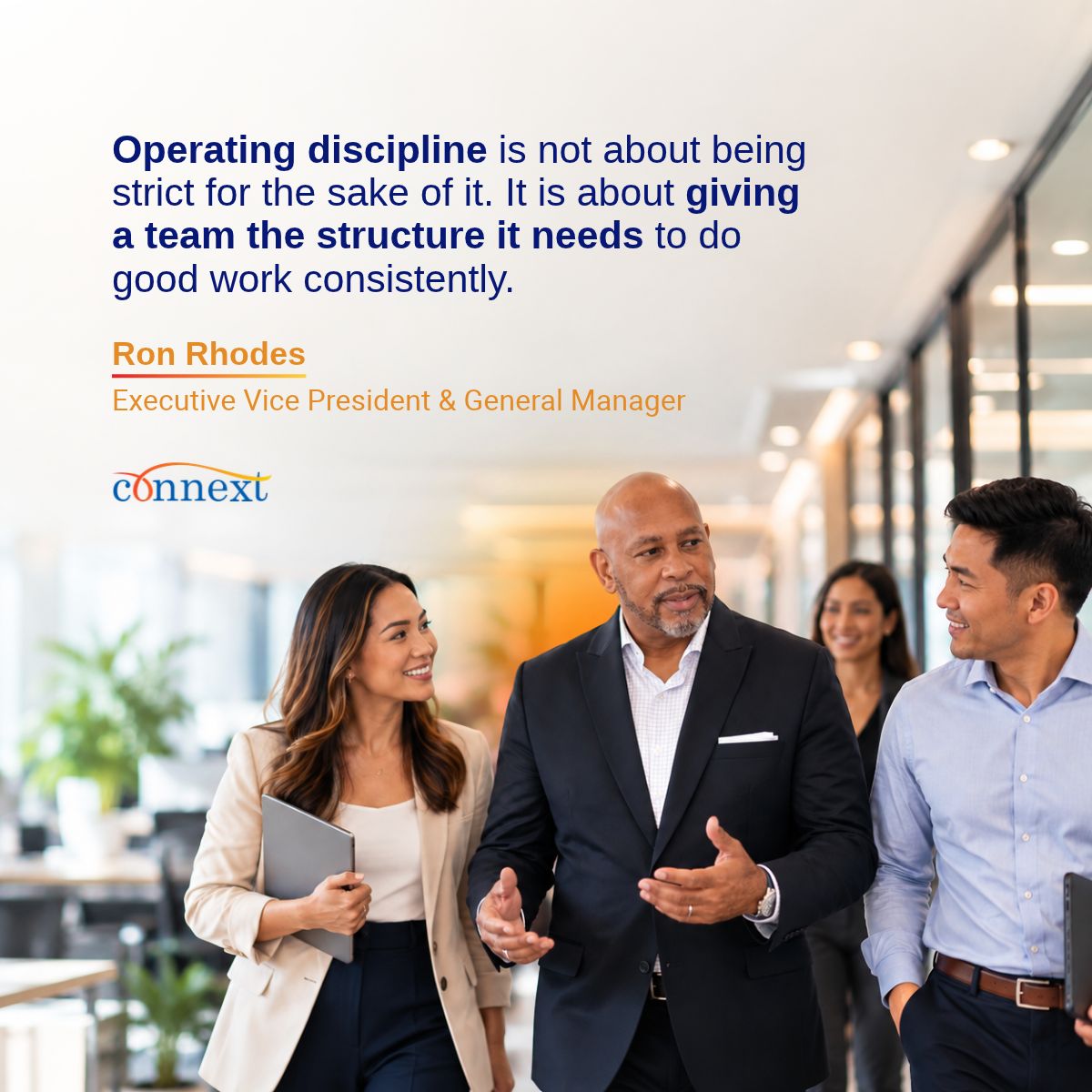
Operating discipline is not about being strict for the sake of it. It is about giving a team the structure it needs to do good work consistently. In my experience, five disciplines carry most of the weight.
- Who Owns the Team's Management Structure?
Every global team needs a clear line of leadership: who supervises daily work, who coaches, and who decides. Without it, questions go to whoever is online, and senior leaders get pulled into frontline issues.
Structure also has to grow ahead of headcount. Our white paper, Scale Offshore Teams Without Losing Control, outlines the 5–10 Rule for frontline leadership and the 30–50 Rule for management oversight. The principle is simple. Layer leadership in before growth creates strain, not after.
- What Does "Good" Look Like for Each Role?
A team cannot hit a standard it has never seen. For every role, leaders should define what a complete, accurate piece of work looks like, how it is measured, and what counts as an exception.
Take a claims or accounts payable team. "Process invoices accurately" is a goal. "Match to PO, flag variances above a set threshold, and route exceptions to the AP lead within the same day" is a standard. The second version is one a new hire can follow on day ten, not day ninety.
Standards also cover the parts of the job nobody writes down. When a new hire leaves early, I encourage our leaders to look at whether we set realistic expectations about workload, client communication, and culture during hiring and onboarding. A clear picture of the role on day one protects both performance and retention.
- What Operating Rhythm Keeps the Team Aligned?
Rhythm is how standards stay alive. Daily check-ins surface blockers early. Weekly reviews look at KPIs and quality trends. Structured 30-, 60-, and 90-day reviews show what is working, where gaps are appearing, and what needs to improve before the team scales.
But a meeting does not create accountability. The follow-through does. A rhythm only helps if it changes what happens after the meeting: someone leaves with clear ownership, the decision is documented, and the next step has a deadline.
- Who Owns the Process When It Breaks?
Completing a task is different from managing the process behind it. Someone needs to oversee how the workflow runs, measure quality, handle exceptions, and identify opportunities to improve.
Before adding global capacity, leaders should make sure these responsibilities are clearly assigned. If people are left to figure things out as they go, the operation needs stronger processes before it can scale.
- How Is Accountability Built Without Pressure?
Accountability is created through systems, not pressure. When every team member understands what they own, how success is measured, when to escalate, and who removes barriers, accountability becomes part of the daily work.
Visibility is the foundation. Shared dashboards, QA results, and regular performance conversations replace opinion with facts. Strong teams are built through feedback, accountability, and continuous improvement, and good operations leaders use process discipline to protect people from preventable friction, not to blame them.
Your Team Is Already Live. Where Should You Start?
You do not need to rebuild the model to fix a struggling team. Start with the symptom you see most often, then trace it back to the discipline behind it. Here is the map I use with leaders:
| What you are seeing | Missing discipline | First fix this month |
| Senior leaders keep getting pulled into routine questions | Management structure | Name a team lead and a decision owner for each workflow |
| Quality varies from one team member to the next | Clear standards | Document the standard for the highest-volume task, with examples of good work |
| Issues surface at the monthly review, weeks after they started | Operating rhythm | Add a weekly KPI and quality review for the next 30 days |
| The same errors keep coming back after they are fixed | Process ownership | Assign one owner to the workflow and review where the process allows the error |
| Performance conversations rely on impressions | Accountability | Share a simple dashboard the team and managers both see |
Pick one row, not five. Fix it, measure it for 30 days, then move to the next. Operational excellence is not a project. It is a daily practice, and teams improve fastest when leaders change one thing at a time and hold it.
How Does Co-Management Work Once the Team Is Live?
Co-management is how we keep those five disciplines in place after the hire. The division of roles is clear, and it matters.
The client leads the work. The client sets priorities, defines the KPIs, owns the outcomes, and has a real say in who joins the team.
Connext supports the structure around the team. Our support covers recruiting, onboarding, HR, payroll, IT, workspace, local leadership, and day-to-day operational support.
Every client works with a dedicated Service Delivery Manager. Under our co-management model, managers check in with employees daily, track client-defined KPIs, oversee coaching and performance plans at the client's direction, and conduct regular business reviews. Connext maintains a 35:1 employee-to-manager ratio to allow more time for individual coaching and support.
The managers themselves go through a four-step selection process: a resume screen, a client-specific case study and panel interview, a Connext immersion activity, and a manager bootcamp before assignment. Development continues through Connext University and our manager training programs.
This cadence holds up under independent review. In KLAS Research's 2026 First Look report, Connext clients described ongoing performance check-ins tied to their own defined KPIs, set by their priorities rather than a generic provider schedule.
Compare this with a model built around seat-count reporting. When a provider reports how many people are working but not how well the work is getting done, the client ends up managing alone. Co-management is a team you manage together, not one you manage alone.
For a deeper look at the difference, see Co-Sourcing vs Outsourcing: The Operational Model Mid-Market Companies Actually Need.
Why Does Strong Management Protect the Cost and Scale Benefits?
Most companies build a global team for two reasons: cost and scalability. For mid-market companies working with a co-managed partner, 45% to 65% in total savings versus domestic equivalents is a realistic range, as outlined in our guide for directors. The upper end of that range depends on low turnover and a well-structured engagement. In other words, the savings hold only when the team performs.
Weak management erodes those benefits quietly. Rework adds hours nobody budgeted. Errors create client-facing issues that pull senior people back into the details. Turnover restarts the training curve. And every open seat has a cost of its own. Connext's Unfilled Role Report 2026 estimates a single unfilled critical role costs an organization about $14,700 per month once lost productivity, overtime, and workload coverage are counted.
Retention is where management shows up most clearly. In staff augmentation, service cannot be delivered if the staff are unavailable due to turnover. The backfill takes time, and the new hire brings a learning curve that affects quality. I explain this in more detail in Why Employee Retention Is a Service Delivery Strategy in Offshore Staffing. Strong daily management, clear expectations, and real support are what keep good people in their seats. At Connext, our co-management model supports an annual retention rate above 80% and a 3+ year average employee tenure.
Scalability depends on the same foundation. Adding people to an undisciplined process multiplies the problems. Adding people to a disciplined process multiplies the results. Growth without discipline creates complexity. Growth with operating discipline creates capability.
Final Takeaway
I have seen many companies treat the hire as the finish line. The companies I have seen build the strongest global teams treat it as the starting line. Talent opens the door. Operating discipline decides what happens next. Clear structure, defined standards, a steady rhythm, real process ownership, and visible accountability are what turn a group of capable people into a dependable operation. The goal is building a reliable operating model that can scale with confidence.
Ready to Build a Global Team With the Structure to Perform?
Schedule a free workforce consultation with a Connext specialist to explore embedded global teams with the management structure, visibility, and accountability needed to perform after the hire.
Visit connextglobal.com/contact or email sales@connextglobal.com.
Like what you’re reading?
Add Connext as a preferred source on Google — it only takes a moment and helps more professionals find our content.




You're done. Thank you!