


Key Takeaways
- Coaching in management shifts the role of a manager from directing work to developing people. Consistency improves performance, strengthens engagement, supports retention, and builds a more capable workforce.
- Employees gain confidence, stronger performance, and clearer career direction. Personalized guidance helps people understand where they are strong, where they need to improve, and how to keep developing.
- Managers build teams that require less constant intervention. Regular coaching conversations strengthen trust, surface performance gaps earlier, and help employees make more routine decisions independently.
- Organizations build engagement, retention, and future leadership capacity. When employees see that their development matters, they have more reason to stay, grow, and prepare for larger roles within the organization.
“We coach to make an impact.” I come back to that line with our managers repeatedly. After more than 30 years in global back-office and customer contact operations, I have learned that performance depends on two things working together: the process and the person responsible for it. Coaching is where those two meet.
Coaching in management is more than a leadership skill. It is part of building teams that can perform consistently, solve problems, and take greater ownership of the work. A manager who only directs the work may get compliance, but a manager who coaches develops people who can think through problems, make sound decisions, and improve the work on their own.
Over time, the impact goes well beyond individual performance. Coaching builds confidence, strengthens engagement, supports retention, and prepares people to take on more responsibility as the organization grows. I see those benefits at three levels: the employee, the manager, and the organization.
What Does Coaching Change for Employees?
Coaching gives employees five things a job description never will: better performance, more confidence, career direction, sharper problem-solving, and a reason to feel good about their work.
Improved Performance
Coaching helps employees identify strengths and areas for improvement. It closes the gap between what the key performance indicator (KPI) says and what good work looks like on a given account.
Increased Confidence
Confidence grows when people get specific feedback, tasks that stretch them, and safety to fail. Managers who combine all three see employees take on harder challenges sooner. It is built on the job, one earned win at a time, and the manager’s role is to set those wins up. This is not a trait you hire for. Managers build it, one feedback conversation at a time.
Career Development
Coaching helps employees set career goals and create development plans. It encourages continuous learning and professional growth. At Connext, we back this with Connext University, a learning hub with four academies covering management, business, professional, and life skills development. A good coach helps each employee pick the right path through it.
Enhanced Problem-Solving Skills
Employees learn to think critically and find solutions independently. Coaching reduces dependency on managers for routine decisions. Every routine decision a team member gets right is time a manager gets back for improving the operation.
Higher Job Satisfaction
Employees feel valued when their development is prioritized. Greater fulfillment improves morale, which often translates into better work quality. Consistent coaching for employee retention also helps employees feel supported in their growth, giving them more reasons to stay with the organization.
What Do Managers Gain From Coaching?
Managers who coach spend less time fixing problems and more time building capability. I have led organizations of more than 3,000 people, and at that scale, a manager cannot be the answer to every question. The team has to carry more of the load.
Stronger Team Performance
Coaching develops employee capabilities, leading to better results. Teams become more self-sufficient and accountable. Accountability is created through systems, not pressure, and a regular coaching cadence is one of the most dependable systems a manager has.
Better Employee Relationships
Regular coaching conversations build trust and open communication. They improve manager-employee engagement. People tell a manager they trust what is actually happening in the work, and visibility creates accountability.
Reduced Employee Issues
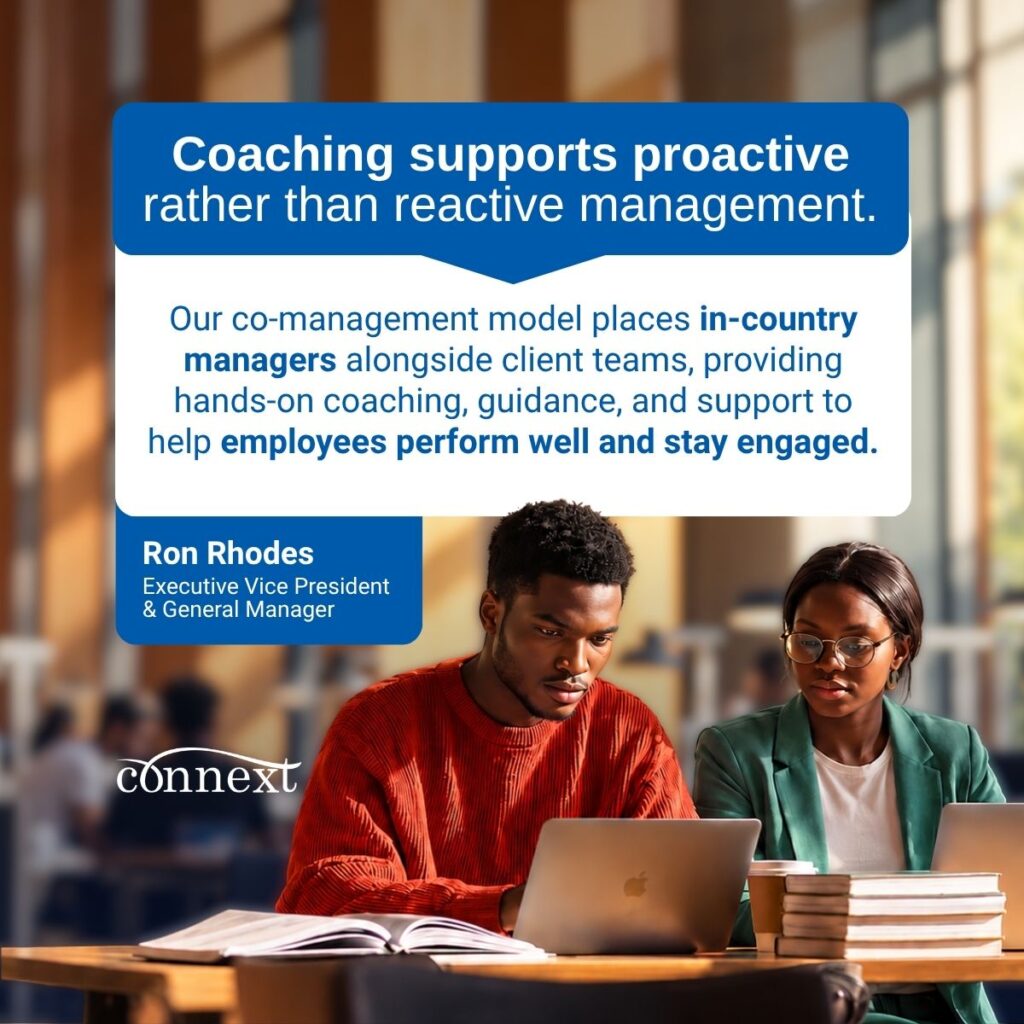
Early identification of performance gaps helps prevent larger problems. Coaching supports proactive rather than reactive management. A manager who sits down with a team member every week catches a slipping metric or a disengaging performer long before it turns into a resignation or a client escalation.
This is a big reason our co-management model places in-country managers alongside client teams, providing hands-on coaching, guidance, and support to help employees perform well and stay engaged.
How Does Coaching Pay Off for the Organization?
When coaching becomes a management habit, the whole organization feels it: in engagement, employee retention, leadership depth, productivity, and culture.
Higher Employee Engagement
Coached employees are more motivated and committed. Engagement translates into stronger business performance.
Improved Retention
Employees stay with organizations that invest in their development. Coaching reduces turnover and hiring costs. In staff augmentation, I treat retention as a service delivery strategy, because the client feels every vacancy and every learning curve.
Connext maintains an annual employee retention rate above 80% and an average employee tenure of more than three years. Coaching is part of how we protect those numbers.
Stronger Leadership Pipeline
Coaching helps identify and develop future leaders, creating succession readiness for key positions. Managers who map each person’s skills against a specific target role, assign stretch work, and advocate for them when openings arise build a pipeline of internal talent and give people a reason to stay. When a team lead gets promoted, the person ready to step in should already be known, and coaching is how you find and prepare them.
Increased Productivity
Better-skilled and more confident employees contribute more effectively. Teams achieve goals faster and with higher quality.
Positive Organizational Culture
Coaching promotes continuous learning, collaboration, and accountability. It encourages a growth mindset across the workforce. Our culture and employee programs support this, but culture is set by the conversations managers have every week.
Final Takeaway
Growth without discipline creates complexity. The same holds true for people. Hiring talent without developing it gives you headcount. Coaching it gives you capability.
Coaching in management transforms the role of a manager from directing work to developing people. When managers coach consistently, employees perform better, teams take on greater responsibility, and clients benefit from an operation that continues to improve rather than one that constantly needs intervention.
Ultimately, we coach to make an impact. The impact shows up in the people first, and then in the results.
Frequently Asked Questions
Employee coaching is a regular, structured conversation between a manager and an employee focused on developing skills, improving performance, and supporting professional growth. Managers provide constructive feedback, identify strengths and areas for improvement, and help employees solve problems independently. The benefits of employee coaching extend beyond individual development to stronger team performance and accountability.
Managing focuses on assigning responsibilities, setting expectations, and monitoring results. Coaching helps employees develop the skills and confidence to meet those expectations independently. While managing keeps daily operations on track, job performance coaching helps employees improve their work, address challenges, and take greater ownership of their responsibilities.
The main benefits of employee coaching include improved job performance, greater confidence, stronger problem-solving skills, clearer career development opportunities, and higher job satisfaction. Through consistent feedback and coaching for performance improvement, employees can identify skill gaps, build on their strengths, and make measurable progress toward their goals.
Coaching for employee retention helps employees feel supported, valued, and invested in their professional development. Regular coaching gives managers opportunities to recognize achievements, address concerns early, and discuss career goals. When employees see a clear path for growth and receive meaningful support, they have more reasons to stay with the organization.
Connext supports employee development through country-specific managers, ongoing performance feedback, and learning opportunities through Connext University. Under its co-managed service model, clients remain directly involved in setting expectations and managing team performance, while local managers provide day-to-day support, identify development needs, and address issues early. This approach helps offshore teams develop their capabilities while staying aligned with client goals and operational standards.
Ready to Build a Team That Keeps Getting Better?
We build dedicated offshore and nearshore teams supported by local management, structured development, and coaching that keeps performance improving as you grow. Start with one professional and scale as your business demands.
Visit connextglobal.com/contact or email sales@connextglobal.com.